What It Costs to Translate a Novel in 2026: AI vs. AI + Editor vs. Human
What translating a book costs in 2026, three ways: a human literary translator, an AI draft with a human editor, and AI alone. Real rates by market, real timelines, a calculator for your word count, and why the human stays in the loop.

On this page
My co-founder Vitalii once wrote 120,000 words of satirical romance fantasy: mages drowning in debt, a multiverse economy that makes Wall Street look ethical, and a love story tangled up in all of it. At the average US literary translation rate of $0.13 a word, a professional translation of that book would cost about $15,600. That is exactly the kind of loan his mages would take out and never pay back.

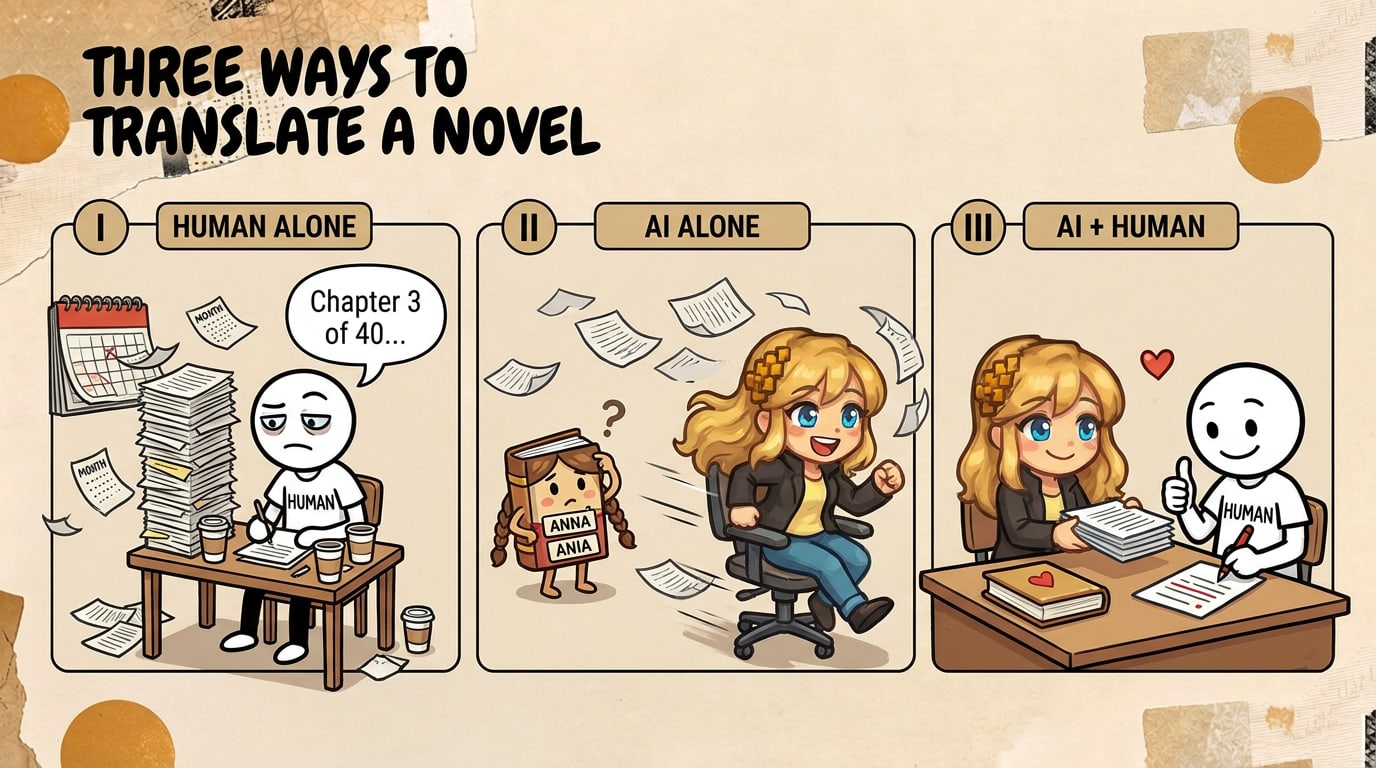
If you have a finished manuscript and a second language in mind, you have probably typed some version of how much does it cost to translate a book? into a search bar or a chatbot. This guide answers it three ways, with 2026 rates, realistic timelines, and a calculator for your own word count:
- a human literary translator, working from scratch
- an AI draft with a human editor over it
- AI alone
I’ll say where we land up front, so you don’t have to scroll for it. Human translators are wonderful, and we would never tell you to skip the human. But for most novels in 2026, the route we would pick is the middle one, and I’ll argue it wins on speed and on quality.
How much does it cost to translate a novel?
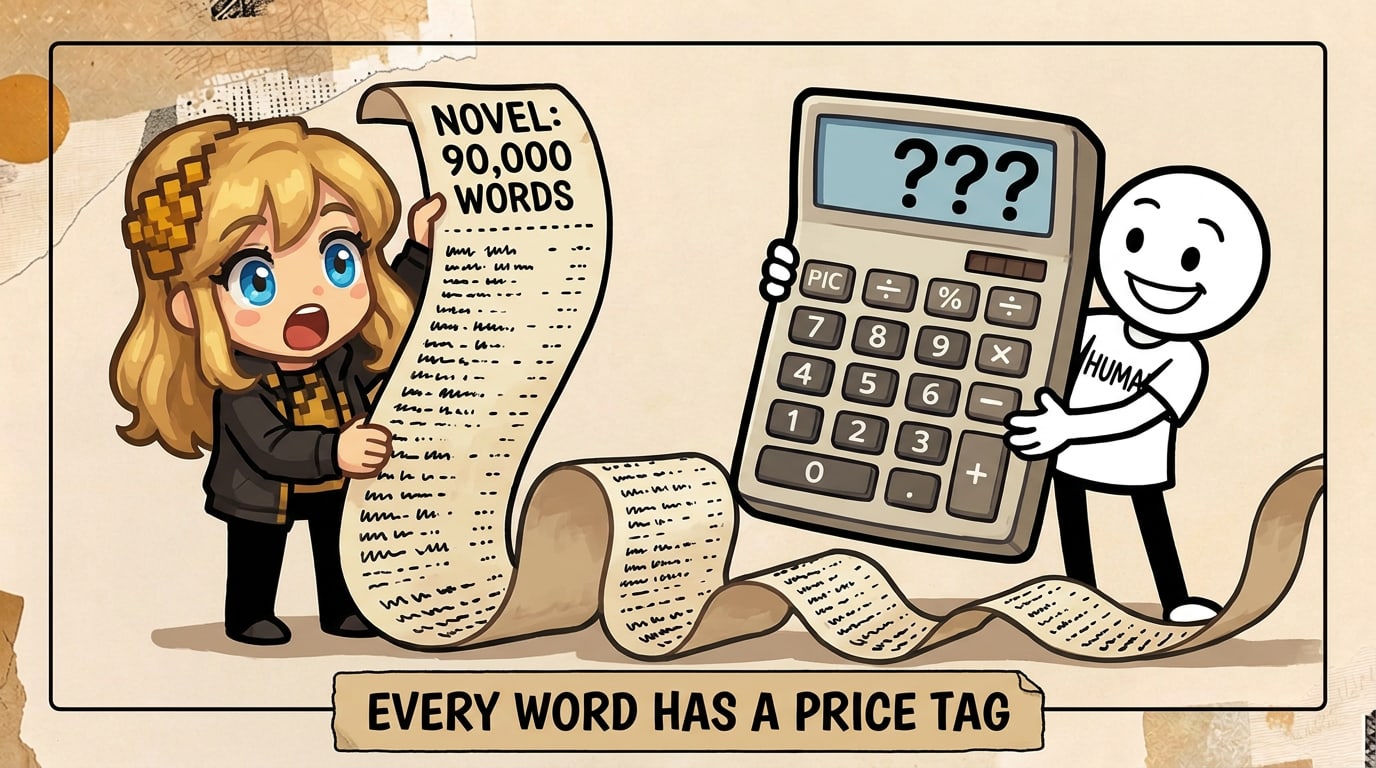
Here are the three routes side by side for a typical 90,000-word novel. The ranges come from the sources in the sections below.
| Route | What you pay | How long | What you get |
|---|---|---|---|
| Human literary translator | about €6,000–€12,000 (€0.07–€0.13 a word) | 4–5 months, full time | One skilled person’s rendering of your book |
| AI draft + human editor | about €1,000–€3,000 for the editor, plus the AI tool | about 3 months | The machine’s consistency and the editor’s ear |
| AI alone | free to a few hundred | hours | A draft that still needs a human |
Your book isn’t 90,000 words, or your translator quoted a different rate? Move the sliders.
What does a human literary translator charge?
Human translation is the gold standard, and it is priced like one. Literary translators charge per word or per page, and the rate depends more on the market than on the book:
| Market | Typical rate | A 90,000-word novel | Source |
|---|---|---|---|
| United States | $0.13 per word (survey average) | about $11,700 | Authors Guild survey |
| United Kingdom | from about £100 per 1,000 words | about £9,000 | Society of Authors |
| Germany, publishers | €19.27 per standard page (Normseite) | depends on the page count | VdÜ fee survey, 2025 |
| Germany, indie authors | €0.07–€0.09 per word; some charge €0.15 and up | €6,300–€8,100 | Skye MacKinnon on The Creative Penn |
| Canada | C$0.25 per word (recommended) | about C$22,500 | LTAC |
Two footnotes worth knowing before you haggle. The Society of Authors says plainly that £100 per thousand words is an observed starting rate, not a recommendation. And in Germany, the VdÜ found the average page rate rose by just 54 cents since its previous survey, with only about 5% of contracts meeting the minimum fees agreed back in 2014. Across Europe, CEATL’s survey of some 3,000 literary translators concluded that even experienced full-timers can hardly make a living from it. So the rate isn’t greed. A novel is months of someone’s working life.
How long does a human translation take?
Ros Schwartz, a veteran literary translator, puts a challenging book at 800 to 1,000 finished words a day; another translator in the same piece drafts about 2,000 a day before revising. At 1,000 finished words a day, a 90,000-word novel is 90 working days, about four and a half months, and that is before anyone takes a holiday.
Speed has always had a price of its own. Constance Garnett translated some seventy volumes of Russian prose and gave generations of English readers their Tolstoy and Dostoevsky. She was so prolific that Joseph Brodsky joked English readers could barely tell the two writers apart, because what they were mostly reading was Garnett (The New Yorker). At the other extreme, Dai Congrong spent eight years translating the first third of Finnegans Wake into Chinese, and the first print run sold out anyway. Your novel sits somewhere between those two.
What does AI translation alone get you?
AI alone is the cheapest and fastest route by a mile. Your options in 2026:
- Amazon’s Kindle Translate. Free, but an invite-only beta for eligible KDP ebooks. It translates from English into French, German, Italian, Brazilian Portuguese, and Spanish, and from those five into English. You can preview the result, but you can’t edit it.
- Per-book services. Translate A Book quotes roughly €5–€300 per novel depending on the mode; Luman (formerly GlobeScribe) starts at $100 per book per language, $140 for an 80,000–100,000-word novel; ScribeShadow runs subscriptions from $49 to $299 a month.
- Do it yourself in ChatGPT, Claude, or Gemini: a subscription, a lot of copy and paste, and a very long weekend.
- An editor built for books, like Transept: billed in credits (a 90,000-word draft uses 90,000 credits in Standard mode or 270,000 in Pro), and the app shows the exact figure before each run.
And the result is good. Surprisingly good. In a 2026 study, avid readers compared human and machine translations of recent novels from French, Polish, and Japanese, and they couldn’t reliably tell which was which: 17 of 30 guessed right, barely better than a coin. Automatic quality metrics even preferred the machine. But when the same readers went passage by passage, they picked the human version 522 times out of 772, and the machine’s quality swung more within a single book than the human’s did.
That swing is the whole problem with AI alone. It is fine most of the time, and across 300 pages, “most of the time” leaves a lot of pages. The usual suspects:
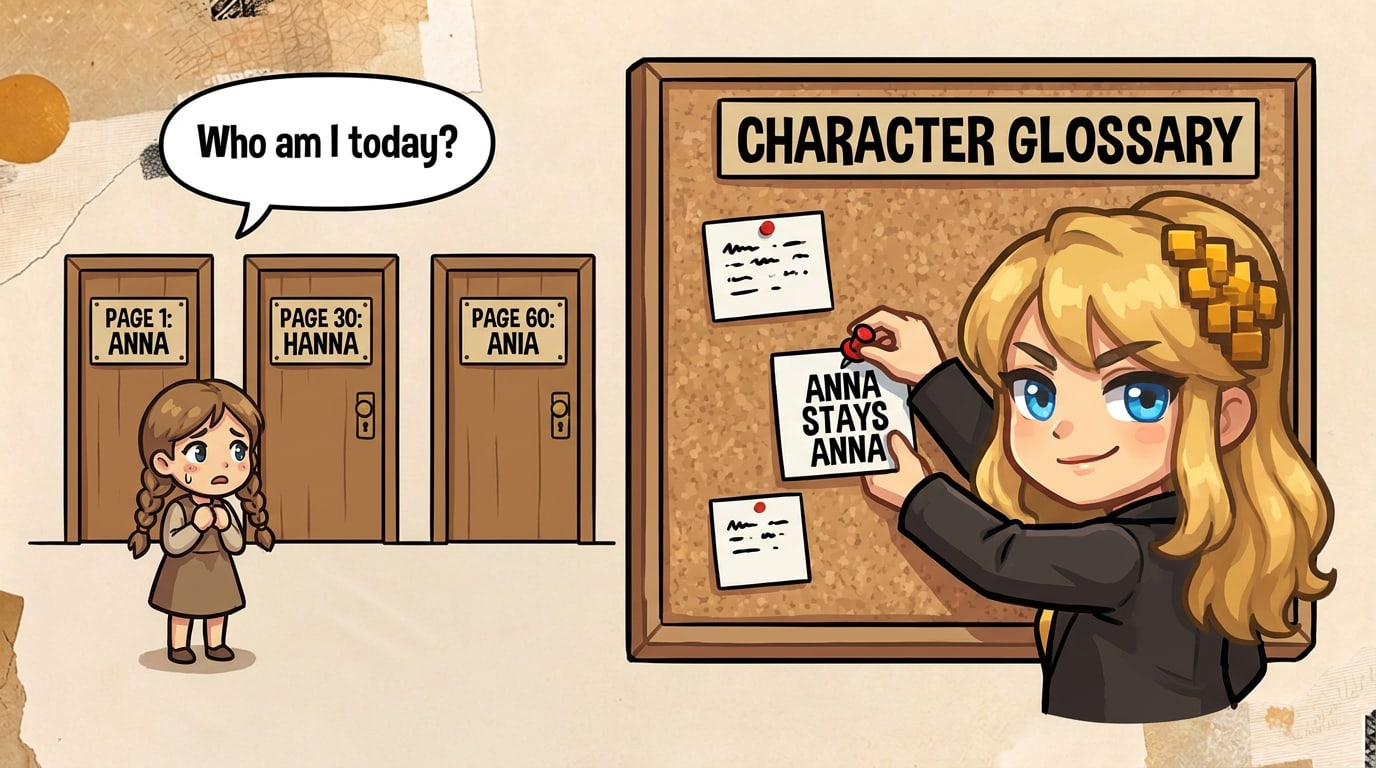
- Names drift. By page 30 the protagonist has three names. In a study of 16th-century letters, language models rendered people’s names correctly only about 60% of the time, and giving the model the right name up front improved that substantially. That, in one sentence, is what a glossary is for.
- Lines go missing. A paragraph-level study across 18 language pairs found the model used context well, yet critical errors persisted, including dropped content. Its authors concluded that a human translator still has to step in.
- The prose goes literal. A 2025 comparison found published human translations consistently beat LLM ones, with the machine output more literal and less varied.
Why is an AI draft plus a human editor better than either alone?
This is our argument, and I’ll be upfront that it is an argument. I couldn’t find a study that puts human-only and human-plus-AI side by side on a whole novel and scores the consistency. What the research does show lines up behind it.
It’s faster, because the machine does the typing. When Toral, Wieling and Way had six professional translators work on Brandon Sanderson’s Warbreaker, post-editing a neural draft made them 36% faster (from 503 to 685 words an hour) with 23% fewer keystrokes. That was 2018 machine translation, with no glossary and no memory of the chapter before. A 2025 study of Margaret Atwood’s Oryx and Crake found that post-editing an LLM draft significantly cut editing time while the translators’ creativity held up.
It’s better, because each part of the work goes to whoever is better at it. Humans are brilliant at voice and terrible at spelling a minor character’s name the same way on page 12 and page 212 after four months of work. Machines are the opposite. So you split the job:
- The machine keeps the book consistent. A glossary pins every name, place, and invented word once, and the draft follows it for all 300 pages. A style sheet holds the register.
- The machine is a second reader. A proofread against the source flags dropped sentences and drifted names, the exact omissions the research keeps finding.
- The human owns everything that makes it a novel. When Jean-François Ménard translated Harry Potter into French, he turned Tom Marvolo Riddle into Tom Elvis Jedusor, so the anagram still spells Je suis Voldemort, and “Jedusor” echoes jeu du sort, a twist of fate. No model invents that on its own. But once a human does, the glossary keeps it straight for the rest of the series.
- The time saved goes where it matters. Your editor stops retyping “she said” four thousand times and spends those weeks on the jokes, the rhythm, and the one line in chapter 9 that makes readers cry.
One honest caveat, because it points to how to work. In a study of literary post-editing, post-edited machine translation scored below human translation on creativity and reader engagement. That fits how post-editing is usually done: the machine translates everything, and a human scrubs the result at the end. Translators in a companion study said they preferred translating from scratch because it left them creative freedom. So the human should steer from the first page, with the glossary, the style sheet, and a read of every chapter as it lands, instead of cleaning up at the end. Vitalii wrote a whole research essay and a hands-on guide on working that way.
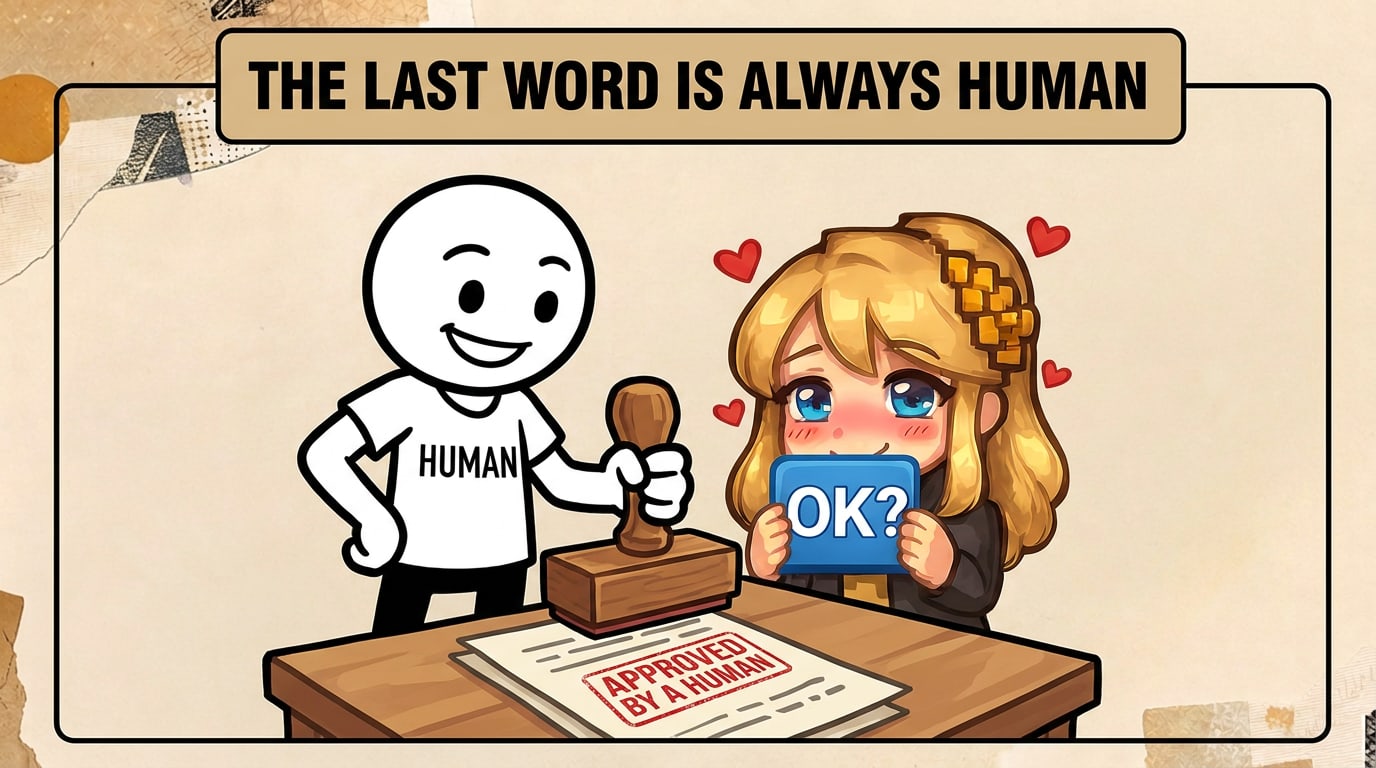
Why can’t you skip the human?
Because the reader can tell where it counts, and because the paperwork assumes a human anyway:
- Readers. The same 2026 study found readers tend to prefer the version they believe is human. Give them one.
- Amazon. KDP’s content guidelines count a translation made with an AI tool as AI-generated even after substantial edits, and ask you to declare it when you publish.
- Copyright. The US Copyright Office’s report on copyrightability protects human contributions, not material generated purely by AI. The more of the translation your editor or you actually wrote, the more of it is protectable. (I’m a co-founder, not a lawyer; ask one for your case.)
Who should the human be?
It depends on which languages you read, and on who you are:
- You, if you’re translating your own book into a language you read well. A Polish author taking their novel into English can review every line in the editor, then hire a native copyeditor for the final polish. The Editorial Freelancers Association lists fiction copyediting at 2.0–2.7 US cents a word, about $1,800–$2,430 for 90,000 words.
- A native-speaking editor, if you don’t read the target language. Ask for a paid sample chapter first. For reference, German publishers pay translators €2–€8 a page to post-edit machine output, which the Guardian notes is about a quarter of the rate for translating from scratch. A literary editor who rewrites for real should cost more than that, and is worth it.
- A literary translator who works with AI. Bilingual, the best quality, and the most expensive of the three. Agree on the scope up front: some translators will happily steer an AI draft, others prefer to write from scratch, and that is their call to make.
- Fans, hobbyists, and web-serial translators. Same workflow, same need for a human pass. One extra rule: translate someone else’s story only with their permission. Archives such as AO3 accept only authorized translations.
How do you budget a translation with AI and an editor?
Seven steps, in the order they save you money:
- Count the words. Your writing app knows. Budget the editor per word, and the AI tool in whatever unit it bills.
- Build a character glossary before chapter one. Names, places, titles, invented words, nicknames, and how each one declines in the target language. This one list prevents most of the expensive fixes later.
- Write a style sheet from a sample chapter. Register, how dialogue sounds, swearing, puns, what to do with songs and poems.
- Draft chapter by chapter, and read as you go. A problem caught in chapter 2 is fixed once. Caught at the end, it is fixed forty times.
- Give your editor a review link, not a Word file by email. They comment on the exact sentence; you see every comment in one place.
- Pay for a sample first. One chapter tells you more about an editor than any rate card.
- Plan the paperwork. Declare the AI translation on KDP, check each other retailer’s rules, and keep your rights in order.
You can do all of this in any tool. I use Transept, because we built it for exactly this job: a glossary that holds for the whole book, a styleguide for the voice, alternatives for every sentence, a proofread against the source, and review links for a native reader who doesn’t need an account.
Is it worth translating your book at all?
Probably more often than you think. According to Slator, fewer than 5% of titles on Amazon.com are available in more than one language, so most genres have room in most languages. Some markets pay better, too: in PublishDrive’s own data, German ebooks average $6.56, about 40% above the US average on the same platform.
A back-of-the-envelope way to decide, with made-up numbers you should replace with yours: say each copy of your German edition earns you €2.50. A €9,000 human translation pays for itself at 3,600 copies. A €2,500 editor over an AI draft pays for itself at 1,000. The exact figures will differ; the ratio between them is the point.
One more story before the FAQ. In 2007, a French 16-year-old translated all 759 pages of Harry Potter and the Deathly Hallows within days of its release, posted it online, and spent a night in jail for it. Speed was never the hard part of translating a book. The hard parts are doing it well and doing it with the right to. And there is room for yours: The Little Prince reached its 600th translation in 2024. Your novel only needs one more.

FAQ
How much does it cost to translate a 300-page book?
A 300-page novel is roughly 75,000–90,000 words, at a rule of thumb of 250–300 words a page. At €0.07–€0.13 a word, a human literary translation costs about €5,000–€12,000. An editor working over an AI draft costs about €1,000–€3,000, plus the AI tool. Your translator’s quote beats any rule of thumb.
Can I translate my book with ChatGPT?
Yes, for a draft, if you work chapter by chapter and paste your character glossary and style notes into every prompt so the model doesn’t have to guess names. What a chat window won’t do is keep 300 pages consistent on its own, check the draft against the source, or give your editor a place to comment. Plan on a human pass before you publish.
What does it cost to translate a whole series?
Book two is where the AI-plus-editor route pulls further ahead. The glossary and style sheet from book one carry over, so the names, places, and voice are settled before the first chapter, and your editor spends less time on consistency with every book. If you work with a human translator, keep the same person for the whole series if you can, for the same reason.
Should I translate the title, blurb, and keywords too?
Yes, and give them more care per word than the book itself. They are the first thing a reader in the new market sees, they are short, and a literal translation of a blurb rarely sells. Have a native speaker adapt them, and look up the keywords readers in that language actually search for.
What should I ask a translator or editor before hiring them?
Ask for a paid sample chapter; whether they charge per word, per page, or per hour, and how they count; how many rounds of revision are included; how they feel about working from an AI draft; and how they want to be credited. Then put the answers in the contract.
Who owns the copyright in an AI-assisted translation?
Translating someone else’s book needs the rights holder’s permission, unless the book is in the public domain. For your own book, what copyright protects in the translation depends on who wrote it: in the US, human contributions are protected and material generated purely by AI is not. This is general information, not legal advice.
The author
Co-founder of Transept. Three degrees in English Language and Literature — Kyiv, Ostrava, and a year in Salzburg — and a Ukrainian native who lives most of her writing life in English. Came into AI as a prompt engineer, then product and lifecycle marketing. She writes semi-fictional stories about real people, and keeps circling the question of what gets lost between languages.