— For sworn and court translators —
Legal documents translated on their original pages
First 5 pages free. No card.
Transept drafts. You certify.
- 01
Upload
A PDF, a scan or a photo. Pick Same pages. The price and the time show before you confirm.
- 02
Draft
The translation arrives on the original pages, with your glossary and style guide applied.
- 03
Review
Source and translation side by side. Keep, edit or redo any line; Smart Proofread lists what to look at first.
- 04
Certify
Export the PDF or the Word file, print it, and add your certification, stamp and signature as you always have. Transept does not issue certified translations; you do.
Every document a client brings, in the form they bring it
Judgments, orders and decisions
The court header, the case number, the margin numbers and the operative part stay where the court put them.
PDF · scan
Notarial deeds and powers of attorney
Numbered clauses, long sentences and the notary’s attestation at the end, each in its place.
PDF · scan
Civil-status certificates
Birth, marriage and death certificates are mostly forms with stamps. The fields keep their layout; only the text changes.
scan · photo
Contracts and company documents
Articles of association, commercial-register extracts, employment and lease contracts, with the defined terms kept the same from the first clause to the last.
PDF · DOCX
Diplomas and transcripts
A table of grades stays a table, with the grading scale next to it.
scan · photo
Apostilles and annexes
The apostille page and the attachments come in with the document and go out with it, in one file.
PDF · scan
Scans, phone photos and handwritten pages are read first (OCR), then translated. Files up to 200 MB.
Translated on the original pages, seals, signatures and all
Choose how the translation comes back before you upload. For a certified translation you usually want the same pages: the client’s layout, the seals and the signature lines stay, and only the text changes.
Three ways in
Same pages
The translation is set onto the original pages. Seals, signatures, logos and everything that isn’t text stay as they were.
Rebuilt pages
Each page is rebuilt in the original’s style, so a language that runs longer than the source gets room. It is a rebuild, not the original page, so keep Same pages for a document that has to look untouched.
Text only
Just the words, as Word or Markdown, for a translation you set on your own letterhead. No layout fee.
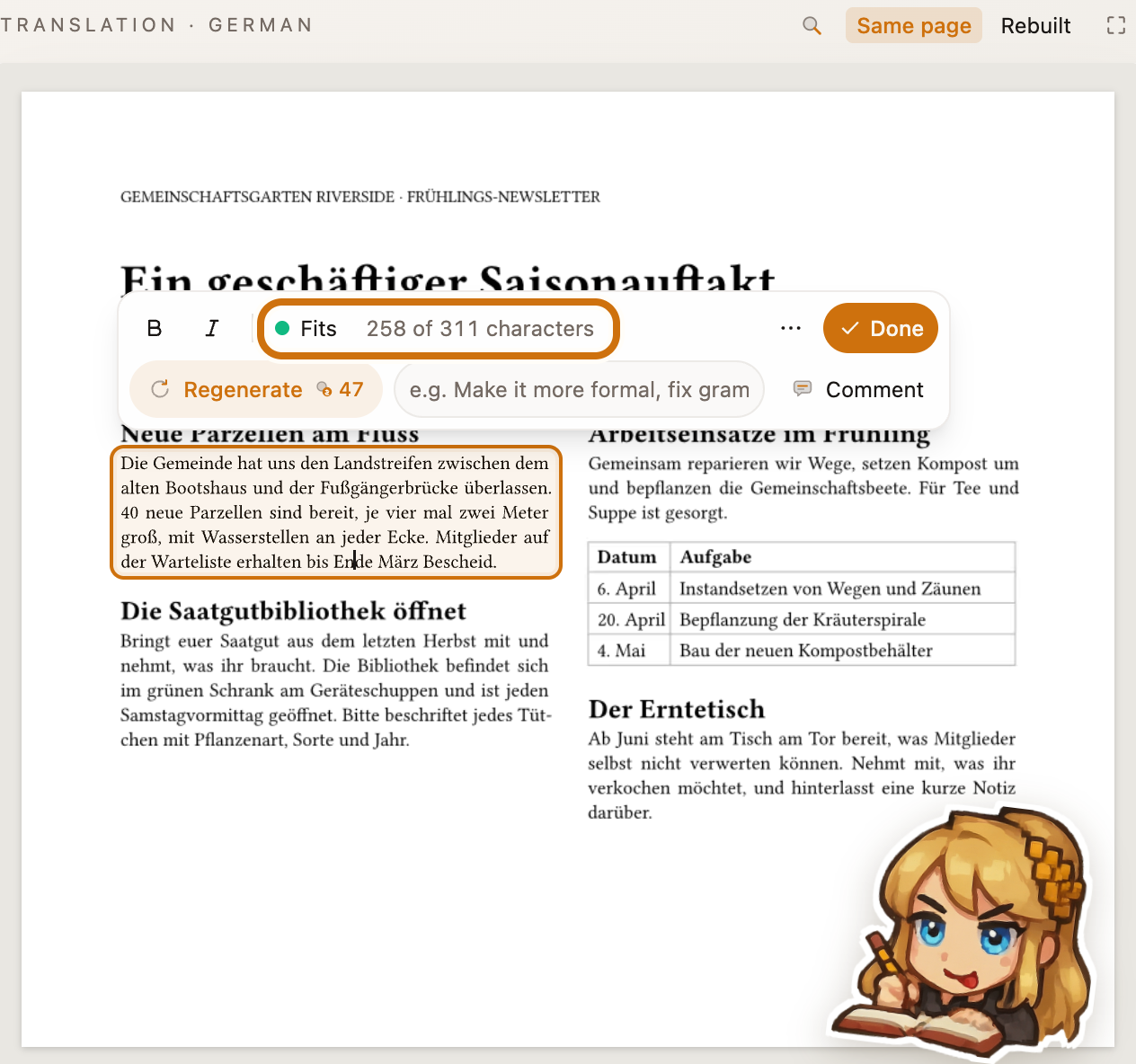
- Correct a line on the page. Click the block, type your wording, and the bar tells you whether it still fits its box.
- Check layout before you certify: it finds every line that runs over its box and shortens it to fit, and you read the result.
- Scans, photos and handwritten pages work too. The text is read with OCR first.
- The price before you upload. Layout costs 200 credits a document plus 80 a page for a digital PDF, 200 a scanned page and 700 a handwritten page, on top of the words.
Names, numbers and citations, the same on every page
A glossary per client
Party names, company names and your standing renderings go in once and apply to every file for that client. Mark a term “do not translate” and it stays exactly as written.
Every line checked against its source
Smart Proofread reads the translation next to the original and flags a dropped line, a shifted meaning or a citation that no longer matches, so you look there first.
Memory across a client’s files
The second contract for the same client follows the choices you made in the first. A sentence you approved once comes back as you approved it.
A style guide for the register
Formal register, how you render the names of courts and offices, how you mark an untranslatable term: write it down once and it applies to every draft.
Where the document goes, and who can read it
You answer for a client’s confidentiality by law and by oath. This is what happens to a document you upload, and the page that backs each line.
Stored in Germany
On Hetzner’s servers in Falkenstein, a data center certified to ISO/IEC 27001. The database and every backup stay in the EU.
One passage at a time
The AI provider receives the passage being translated, for the length of that request. It never receives your file.
Never used to train AI
By nobody: neither by us nor by Anthropic, OpenAI or Google under the API terms we use. We run no models of our own.
Nobody reads it
Our logs record requests and errors, never document text. Our team doesn’t open customer documents; for a support question we ask you first, and ask which document.
Gone when you delete it
Delete a document when the job is delivered and it leaves the database at once, translation included. Delete the account and everything goes with it.
A published DPA
Our Data Processing Agreement is public and applies without a signature: breach notice within 72 hours, every sub-processor listed, and the entry for your records of processing ready to file.
What we don’t have yet: a SOC 2 audit or an ISO 27001 certificate of our own. The security page says so, in the open.
Built for work you answer for
Private by default
Your text is never used to train AI, not by us and not by any provider we use, and it stays out of our logs. Delete your account and your text is deleted with it.
How we handle dataSecurity you can check
Hosted in Germany, in Hetzner’s ISO 27001-certified data center. Every sub-processor is listed, and a DPA is one email away.
All sub-processorsGive it context
Glossaries, style guides, translation memory and per-string notes go with every request. You set them up once per project.
GlossariesYou’re the human in the loop
The AI drafts; you decide. Review every change side by side, keep or revert it, and send a review link when a client needs to look.
Review linksAPI, MCP and webhooks
The full API on every paid plan. Connect Claude or another AI assistant over MCP, or start runs from your own tools.
Developer guideSomething bigger?
Large catalogs, custom workflows, a DPA for procurement. Transept stays self-serve; write to us for the rest.
support@transept.ai
Show clients your post-editing
When a client asks how much of a translation was machine output and how much was your work, send them the report. It counts your edits by word, lists every paragraph you reviewed, and carries your confirmation that you read the whole text.
- Counted by word. The words the AI wrote, the words you changed and the paragraphs you wrote yourself, each counted on its own.
- Every step on record. Translations, rewrites, fixes, your edits and your approvals in one list, each line marked as yours or the AI's.
- Your sign-off, dated. Before the PDF downloads, Literess asks whether you read the translation through. Say yes and the report records it.
Two reports on the Free plan, unlimited on every paid plan.
Originality report
Chapter 3 · Ukrainian → English
Reviewed in full by the author, confirmed on Oct 21, 2026
✦From our labs
8 hours → 50 minutes
One 40,000-word document, translated by several agents at once, used to take eight hours. We got the agents to sync their memory mid-run, so a term settled in clause 2 still holds in clause 400. It now finishes in fifty minutes.
How the syncing worksFAQ
- No. It produces the draft, on the original pages, and the tools to check it against the source. The certification, the stamp and the signature are yours, under the rules of your register, exactly as before. Our terms say the same: a translation for legal use needs a qualified person’s review before it is used.
- The work is the same wherever you are sworn: Transept drafts, you review and certify. The native titles differ, and the page is for all of them: tłumacz przysięgły in Poland, beeidigter or ermächtigter Übersetzer in Germany, allgemein beeideter und gerichtlich zertifizierter Dolmetscher in Austria, soudní překladatel in Czechia, traducteur assermenté in France, beëdigd vertaler in the Netherlands, traductor jurado in Spain. Ukraine has no sworn-translator register; a notary certifies the translator’s signature there, and the draft fits that route too. 68 languages, in any direction.
- If you translate for a firm, a court or an authority, you may be asked for one. Ours is published at /dpa and applies to your account without a signature; it covers sub-processors, security measures and breach notification under GDPR Article 28, and ends with the entry for your records of processing, also as a PDF in English, German and Polish. If someone needs a countersigned copy, email support@transept.ai from your account address.
- A scan, a PNG, JPG, WebP or TIFF image and a handwritten page are read with OCR first, then translated like a digital PDF. A phone photo works when the page is readable in it. The layout fee is 200 credits a scanned page and 700 a handwritten page; the words are billed like any other text.
- They stay on the page, in the same place, as they are. Everything the engine reads as text is translated; a seal or a signature stays an image, and you describe it in your translator’s note as you do today.
- The order in the demo is about 1,500 words. In Standard that is 1,500 credits for the words plus the layout fee for a digital PDF, 200 for the document and 80 a page, so about 2,000 credits in all. The Free plan’s 5,500 credits a month cover it; the Lite plan is €9/$10 a month for 25,000. Exporting is free.
- Send a review link: the reader sees source and translation side by side and can comment, without an account and without being able to edit. A link expires after 30 days, and you can revoke it earlier.
- 68 languages, in any direction, among them Ukrainian, Polish, German, Czech, Slovak, French, Dutch, Italian, Spanish, Portuguese, Turkish, Arabic, Chinese and Japanese. One document can carry several target languages at once.
Featured on