Translation Memory: What It Is, How It Works, and Why It Matters for AI Localization
A translation memory stores the lines your team already approved. We needed to figure out what TM means when the translator is an LLM, how the tools on the market remember (or forget), and the bet we made at Transept: memory as decision context.

On this page
If your team translates product content, support articles, documentation, campaigns, or software strings, you keep running into the same problem:
- the same phrases appear again and again,
- yet they still cost time to translate, review, and approve every single time.
That is exactly what translation memory is built to solve.
A translation memory, or TM, is where your translation setup keeps the lines your team has already approved. Source text goes in, the final translation sits next to it, and the next time something similar shows up, you do not start from zero.
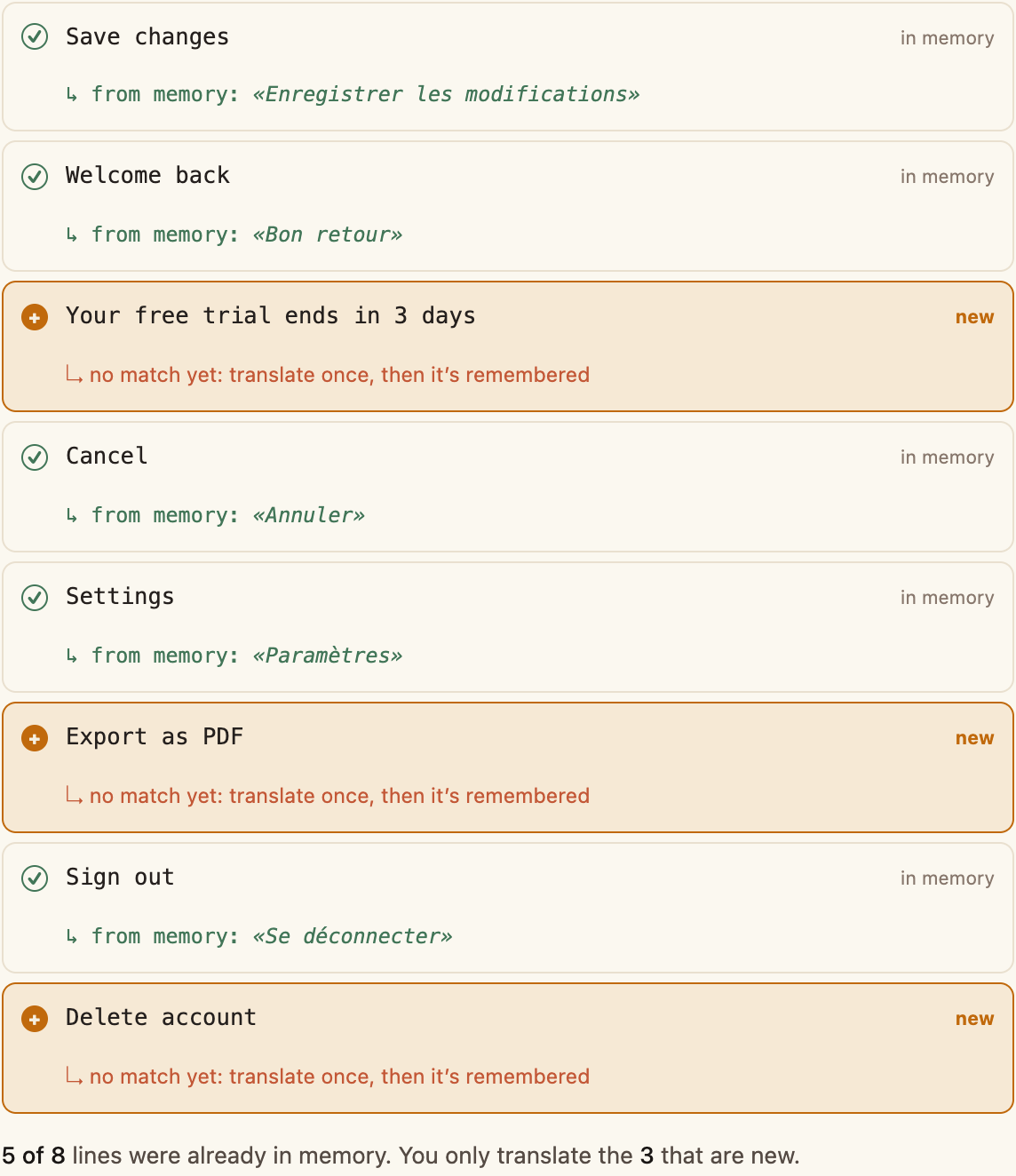
Old translation tools used it to save time. With AI it matters even more: it shows the model what is your translation standard, and what decisions are expected. The payoff is tremendous:
- faster turnaround (no re-translating boilerplate, disclaimers, or repeated UI)
- lower cost, not only because you can reuse lines. With enough TM grounding, we in Transept managed to make a 4× cheaper model match a premium one
- consistent style (decisions you approved years ago is the one every new feature reuses).

But how do you do translation memory with AI translation?
- Do glossaries and styleguides count as TM? How do you keep them up to date?
- How do you decide what counts as a relevant TM segment?
- How much context does the AI need? What is too little, and what is too much?
- How do you make sure a client's copyrighted and sensitive information never leaks to other clients?
That is exactly what we had to figure out at Transept. What should translation memory mean when the translator is no longer only human? And how do we make the human work with that memory meaningful instead of processing a list of slop?
That question is what sent us down the rabbit hole.
What is translation memory in AI translation?
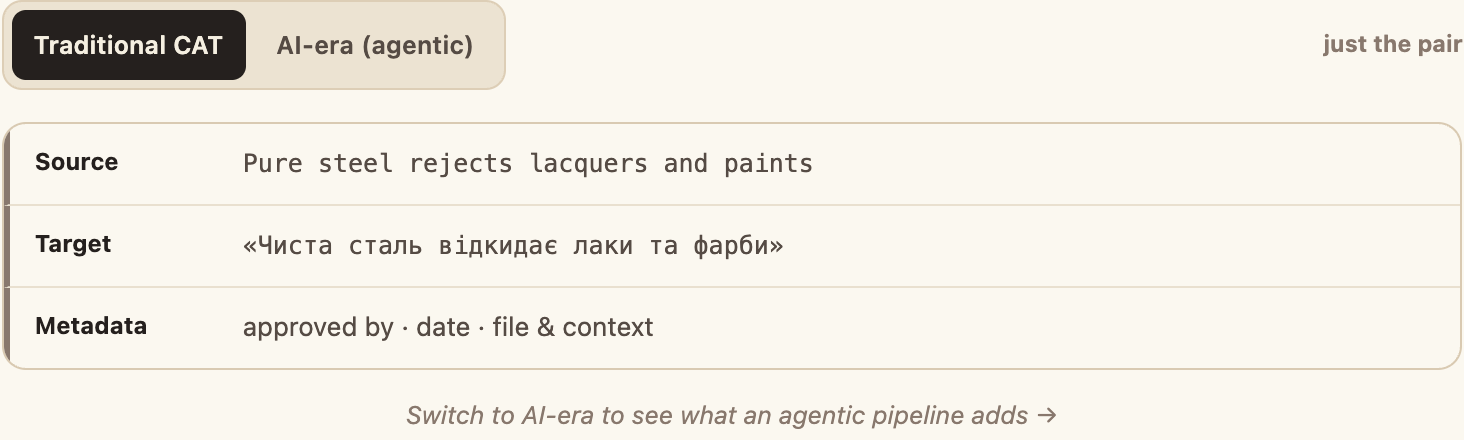
Traditionally, a translation memory is a structured database of translated text pairs. Each pair usually holds:
- The source segment (the original text).
- The target segment (the translation).
- Metadata — who translated it, when it was approved, the surrounding context.
When a translator opens a new document, the TM software scans the text, compares it to the database, and when it finds a match, suggests the previous translation.
That is the classic CAT definition. Once you are working with LLMs and agentic translation systems, several more artifacts come into play:
- Glossaries generated as translation progresses, to stabilize the terminology the AI uses.
- Handoff notes and summaries produced when AI agents pass work between each other.
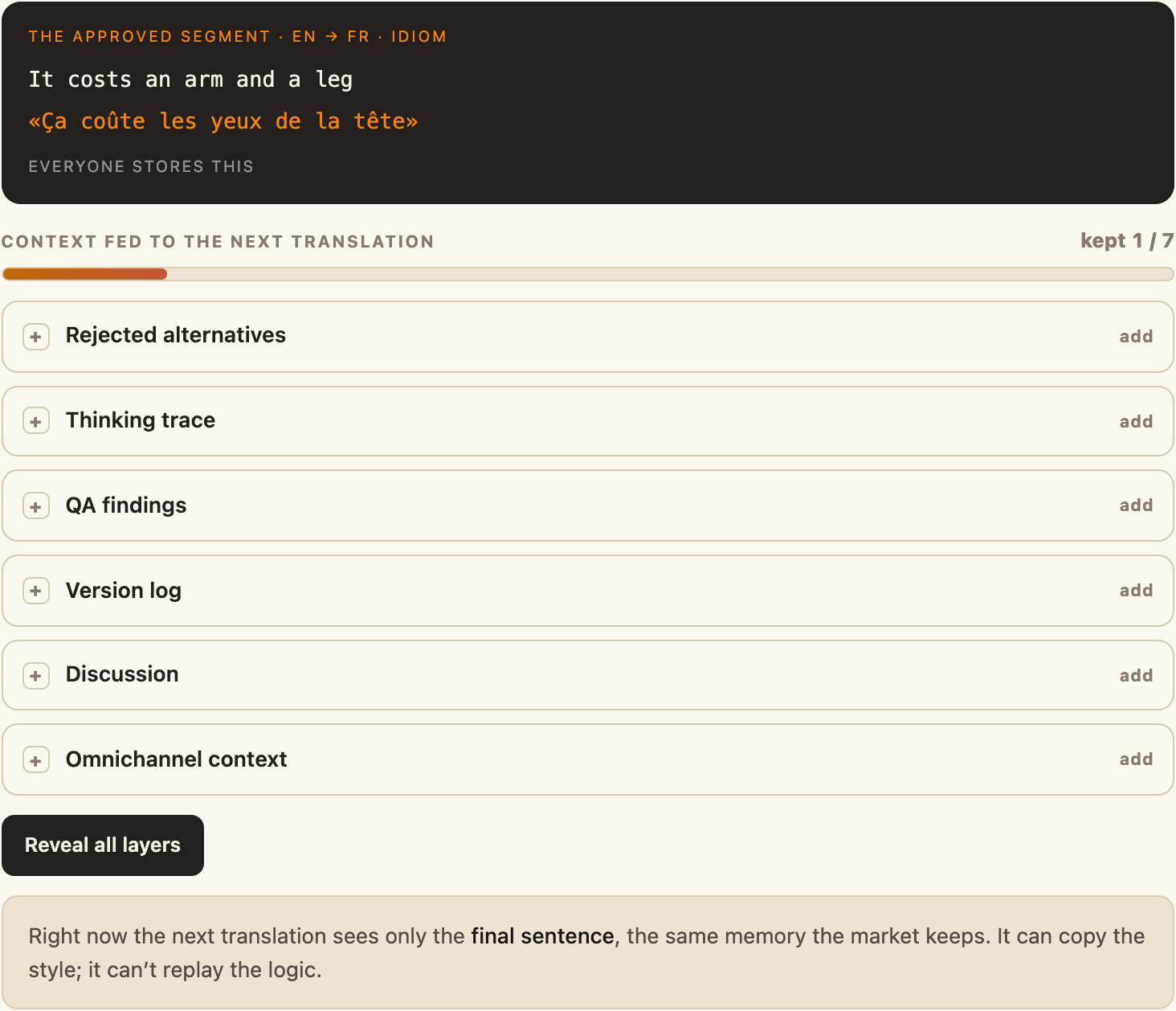
- Thinking traces from agents, created during translation, editing, and proofreading — the why behind each decision.
- Discussion context between agents and humans: chats, reply threads, search histories, Slack/Teams context.


This is still useful for humans, but it is critical for AIs. It lets the model rebuild the context that human translators carry in their docs, their brains, and their conversations. Ironically, LLM-powered translation needs TM and CAT tooling more than humans do — a human can translate just fine with a pen, paper, and a dictionary.
How translation memory matches work
TM software breaks content into smaller pieces called segments — usually a sentence, a heading, or a button label. Then it looks for matches. How the TM searches for matches is the most important discipline in the whole field.
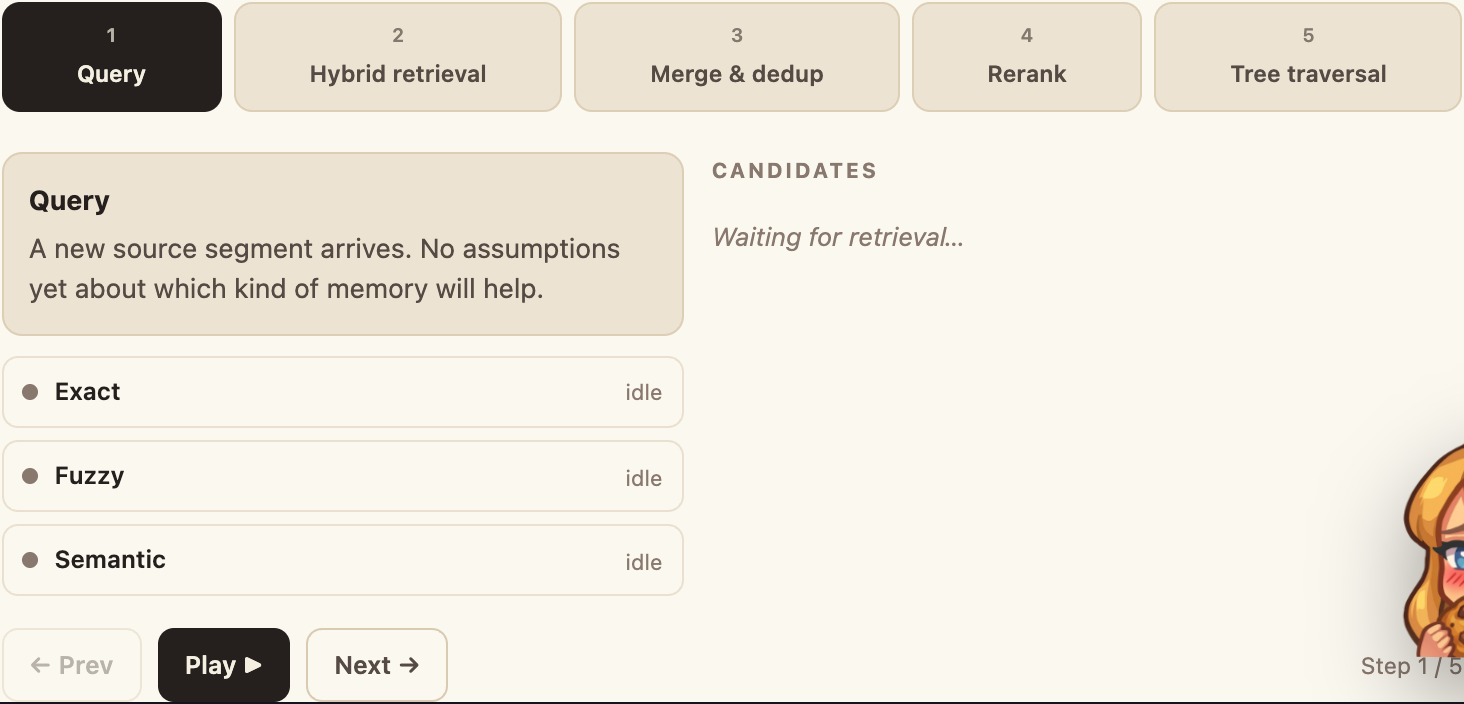
- Exact matches: the new segment is 100% identical to one in the database. The software can fill the translation in automatically.
- Fuzzy matches: similar but not identical. Flagged for a human to review, update, or use as inspiration. Usually powered by a sparse search — searching for every word or lexeme in the sentence, then scoring database segments by how many they share.
- Semantic matches: a segment in the database means something similar even though no words overlap. This uses dense search — vector embeddings and retrieval. Your usual RAG play.
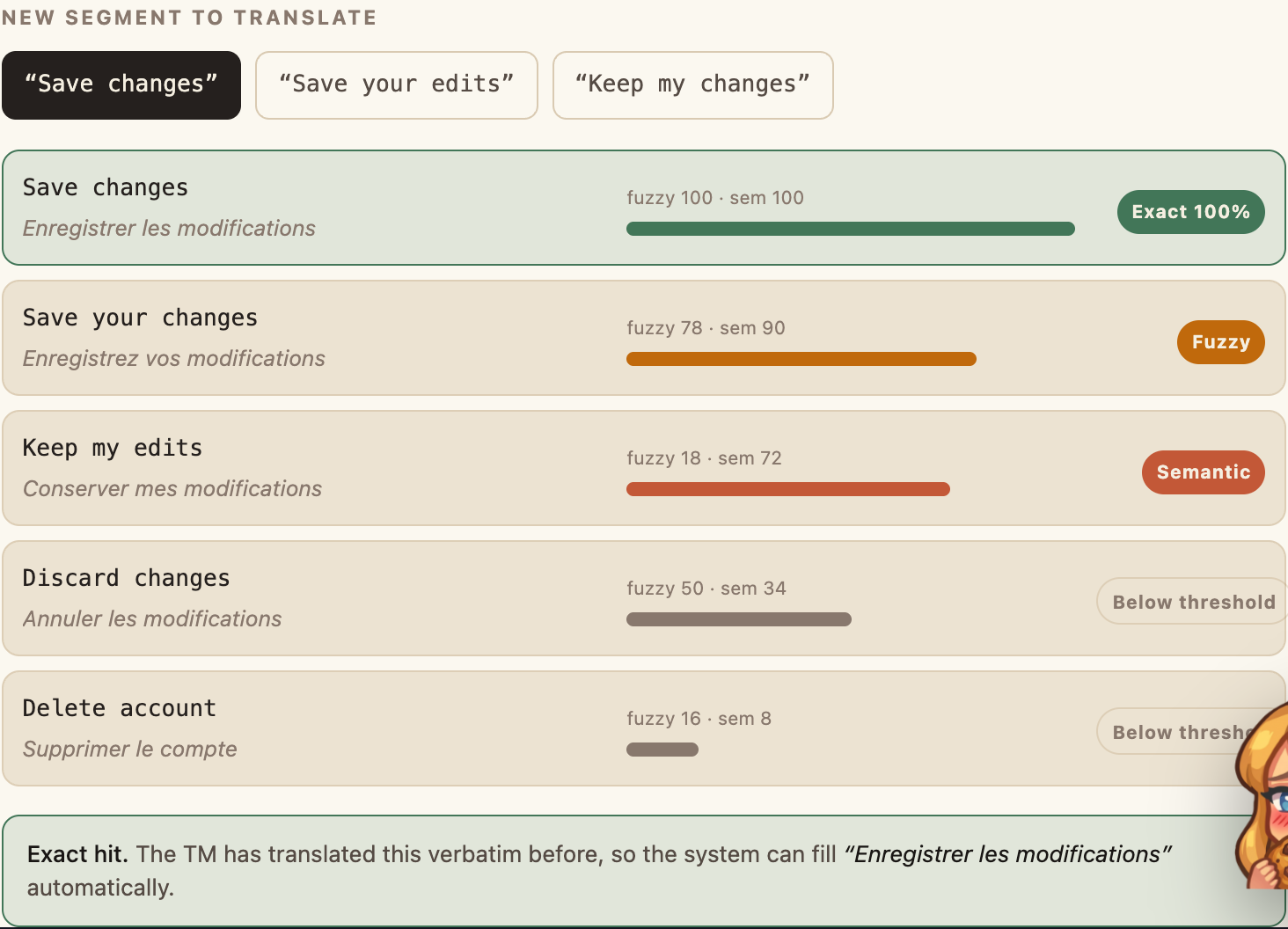
Traditional TM relied on exact and fuzzy matches. LLMs brought the semantic layer. But semantic search alone is still not enough for good performance.
In literary translation, fuzzy term matches are critical for keeping proper nouns and lore consistent. In healthcare, the same thing can be phrased many ways, so semantic search should help — except it backfires. For a general-domain embedder, the distance between ileum and ilium is as small as between crimson and scarlet.
(The ileum is the final part of the small intestine; the ilium is the large upper part of the hip bone. Completely unrelated terms that collapse to "healthcare stuff" in general-domain semantic space.)
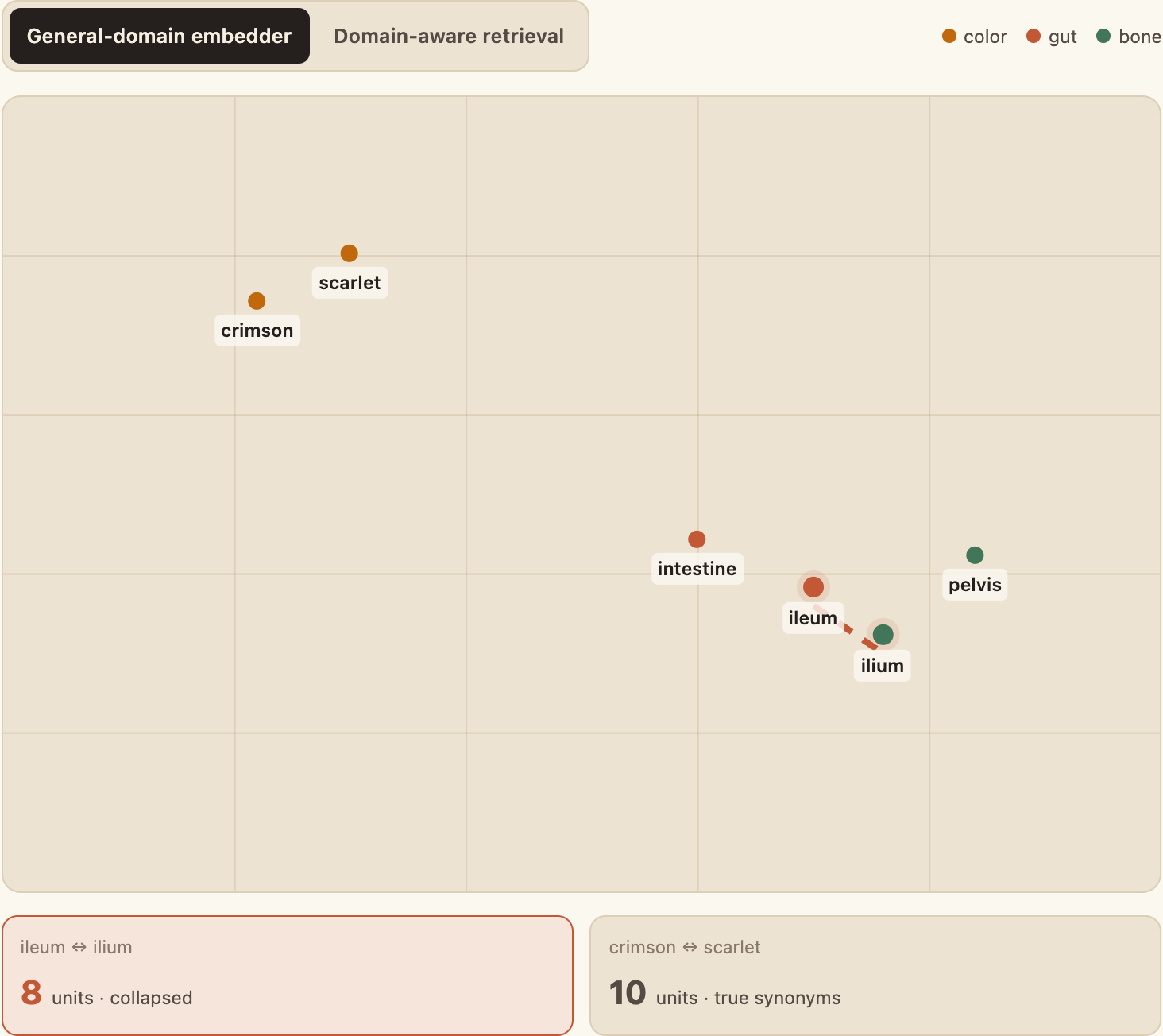
So you need guardrails. The default expectation for translation memory in 2026 is therefore:
- Hybrid search, where exact, fuzzy, and semantic matches are combined for the most relevant results from past translation history.
- Reranking, where the candidates are re-scored against the actual context for relevance.
- Tree traversal, where a human or agent can step from one match to its nearest neighbours to explore the database.
How the rest of the market does translation memory
Every serious localization tool can store past translations and suggest them again. The useful questions are: what does the system remember, when does it trust that memory, and where does it use that memory next?
From that angle the market falls into three levels — memory as reuse, memory as governance, and memory as AI fuel. Transept's bet is a fourth: memory as decision context.
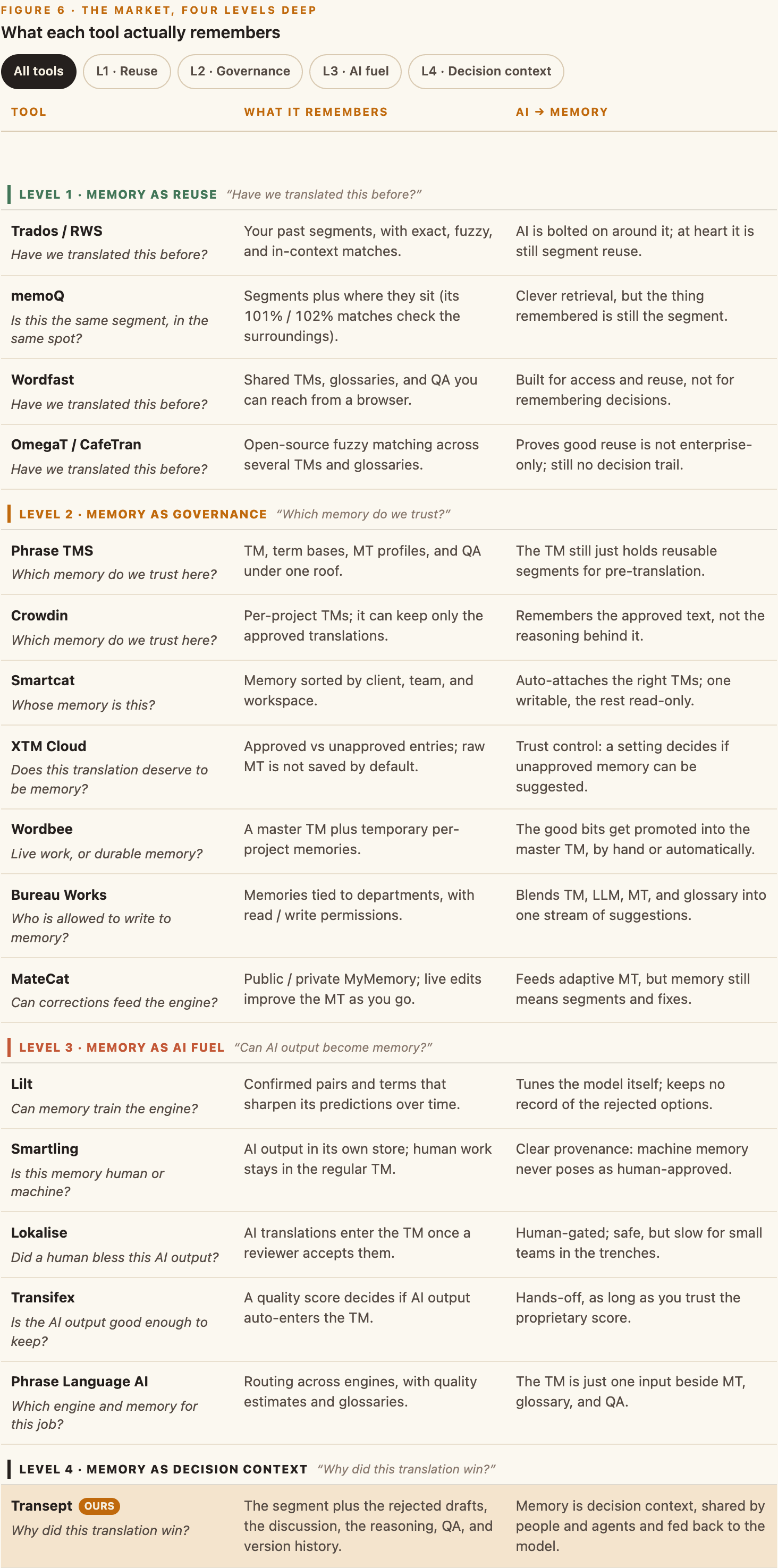
| Tool | What it remembers | AI → memory |
|---|---|---|
Level 1 · Memory as reuse“Have we translated this before?” | ||
Trados / RWS Have we translated this before? | Your past segments, with exact, fuzzy, and in-context matches. | AI is bolted on around it; at heart it is still segment reuse. |
memoQ Is this the same segment, in the same spot? | Segments plus where they sit (its 101% / 102% matches check the surroundings). | Clever retrieval, but the thing remembered is still the segment. |
Wordfast Have we translated this before? | Shared TMs, glossaries, and QA you can reach from a browser. | Built for access and reuse, not for remembering decisions. |
OmegaT / CafeTran Have we translated this before? | Open-source fuzzy matching across several TMs and glossaries. | Proves good reuse is not enterprise-only; still no decision trail. |
Level 2 · Memory as governance“Which memory do we trust?” | ||
Phrase TMS Which memory do we trust here? | TM, term bases, MT profiles, and QA under one roof. | The TM still just holds reusable segments for pre-translation. |
Crowdin Which memory do we trust here? | Per-project TMs; it can keep only the approved translations. | Remembers the approved text, not the reasoning behind it. |
Smartcat Whose memory is this? | Memory sorted by client, team, and workspace. | Auto-attaches the right TMs; one writable, the rest read-only. |
XTM Cloud Does this translation deserve to be memory? | Approved vs unapproved entries; raw MT is not saved by default. | Trust control: a setting decides if unapproved memory can be suggested. |
Wordbee Live work, or durable memory? | A master TM plus temporary per-project memories. | The good bits get promoted into the master TM, by hand or automatically. |
Bureau Works Who is allowed to write to memory? | Memories tied to departments, with read / write permissions. | Blends TM, LLM, MT, and glossary into one stream of suggestions. |
MateCat Can corrections feed the engine? | Public / private MyMemory; live edits improve the MT as you go. | Feeds adaptive MT, but memory still means segments and fixes. |
Level 3 · Memory as AI fuel“Can AI output become memory?” | ||
Lilt Can memory train the engine? | Confirmed pairs and terms that sharpen its predictions over time. | Tunes the model itself; keeps no record of the rejected options. |
Smartling Is this memory human or machine? | AI output in its own store; human work stays in the regular TM. | Clear provenance: machine memory never poses as human-approved. |
Lokalise Did a human bless this AI output? | AI translations enter the TM once a reviewer accepts them. | Human-gated; safe, but slow for small teams in the trenches. |
Transifex Is the AI output good enough to keep? | A quality score decides if AI output auto-enters the TM. | Hands-off, as long as you trust the proprietary score. |
Phrase Language AI Which engine and memory for this job? | Routing across engines, with quality estimates and glossaries. | The TM is just one input beside MT, glossary, and QA. |
Level 4 · Memory as decision context“Why did this translation win?” | ||
TranseptOURS Why did this translation win? | The segment plus the rejected drafts, the discussion, the reasoning, QA, and version history. | Memory is decision context, shared by people and agents and fed back to the model. |
Level 1: memory as reuse
Classic CAT tools answer the oldest TM question: "Have we translated this before?"
They are not primitive — many support context-aware matching, fragment recall, MT plugins, team servers, and strong editor workflows. But memory mostly sits beside the editor as a suggestion source. It helps the translator reuse past work; it does not usually remember why one version was chosen over another.
- Trados / RWS is the classic CAT baseline — strong at exact matches, fuzzy matches, concordance, and in-context exact matches, and the wider Trados ecosystem now folds in AI and Language Weaver workflows. But at the TM level, the core idea is still segment reuse inside a CAT environment.
- memoQ pushes classic TM especially far on context. Its 101% and 102% matches try to decide whether the same segment appears in the same place — which matters for software strings, repeated labels, and structured files. Smart retrieval, but the remembered object is still the segment in context.
- Wordfast keeps TM portable and practical. Wordfast Anywhere gives translators browser-based shared TMs, glossaries, QA, and MT. The value is accessibility and reuse, not a deeper memory of decisions.
- OmegaT and CafeTran show serious reuse is not only an enterprise feature — free, open-source fuzzy matching, match propagation, multiple TMs, and glossary support, with team-oriented TM servers for power users.
So the baseline is already high. Even low-cost and indie tools remember and reuse translations well. The commercial competition begins on what happens after reuse.
Level 2: memory as governance
The next group asks a different question: "Which memory should be trusted for this client, team, project, or workflow?"
- Phrase TMS treats memory as one managed resource inside a larger platform — TM, term bases, MT engine profiles, Phrase Language AI, quality scoring, QA. Broad coverage, but the TM itself still mainly stores reusable segments.
- Crowdin makes memory useful at project scale: auto-created project TMs, the option to store only approved translations, and a distinction between plain 100% matches and Perfect matches (text and context). It pre-fills strings, but still remembers approved text, not the reasoning.
- Smartcat organizes memory around the relationship — clients, departments, workspaces, AI Translation Profiles — auto-attaching the relevant memories and glossaries, with one write-enabled TM and others read-only. The strength is routing and ownership.
- XTM Cloud treats memory as something that needs status and protection: entries can be approved or not, raw MT is not saved automatically, tracked-change segments wait until accepted or rejected, and settings decide whether unapproved memory can be suggested. The point is trust control.
- Wordbee separates durable Translation Memories from temporary Project Memories. A Project Memory captures live work and can suggest segments mid-flight; afterwards the useful parts are consolidated into a master TM. Close to live document context, but still a segment store.
- Bureau Works leans into control — memories linked to departments, read/write permissions (grunt translators may use them; only locale leads may add to them), and a single recommendation stream blending TM, LLM, classical MT, and glossaries. Powerful, occasionally overwhelming, and the final judgment still rests on a human reading the suggestions.
- MateCat is a web CAT editor wired to MyMemory for TM and ModernMT for MT. Public and private memories feed MT suggestions, and live corrections improve output as the translator works — closer to "TM feeding adaptive MT" than simple TM beside MT. Still, the memory means segments, matches, and corrections.
Level 3: memory as AI fuel
The newest group asks what happens when AI creates, edits, or learns from translation. Can machine output become memory? Does it need review first? Can a quality score replace human approval? Can TM steer the engine itself?
- Lilt treats TM as fuel for adaptive MT — confirmed translation units and termbase data improve predictive suggestions over time. The bet is adaptive prediction inside the engine, not a broader memory of comments, rejected alternatives, and review reasoning.
- Smartling makes provenance explicit: AI output can go into a separate Machine-Created Translation Memory, while human or human-validated work stays in the regular TM. A strong trust model — AI output is reusable but never silently poses as human-approved.
- Lokalise uses review as the trust gate: AI or MT translations can enter TM when a reviewer accepts them in a Review task, even without editing the text. AI output can earn durable memory, but only through a human step — which adds friction, and is not ideal for small teams where decisions happen in the trenches and should be captured immediately.
- Transifex uses TQI as an automation gate. Normally generated translations do not enter TM without review, but Transifex AI can score a translation with its Translation Quality Index, and above a configured threshold it can be added automatically. The catch: you have to trust the proprietary index.
- Phrase Language AI is the orchestration layer — routing work across engines and agentic workflows, using quality estimation, applying glossaries, managing MT profiles, supporting bring-your-own engines. Strong system design, but TM remains one input among MT, glossary, QA, and routing.
The gap we found in the market
Across all of these, the market is getting good at storing the final translation, separating human and machine output, routing the right memory, and deciding when AI output is reusable. We treated all of that as the default.
What is still rare is memory of the work around the translation. Few tools keep rejected alternatives, comments, review history, search context, approval logic, and the decision path that explains why one version won. Translation generates this engineering gold naturally — and almost nobody bothered to dig it up.
Rarer still is feeding that history back into a capable LLM so the next translation can use the reasoning, not just the final output.
That is the bet we made at Transept. Translation memory should not only remember the sentence, however important the sentence is. It should remember the work that made the sentence trustworthy. TM must become decision context — shared by humans and AIs alike.
How Transept implements translation memory
At Transept we want to build the state of the art for the quality of translation you can reach with LLMs.
Back when we were solo authors and translators without funding, AI was the only accessible solution. LLMs do not show their full potential without human input — but that input is the most valuable resource in the world: the time of somebody's life. So instead of treating memory as a passive database, we built it as an active participant in the workflow. It feeds constantly, and it constantly gives back.
Hybrid search and granular filtering
Transept's translation memory runs on a hybrid search that combines fuzzy and vector retrieval — fast and accurate. But retrieval is only half the battle; the other half is control over what gets retrieved.
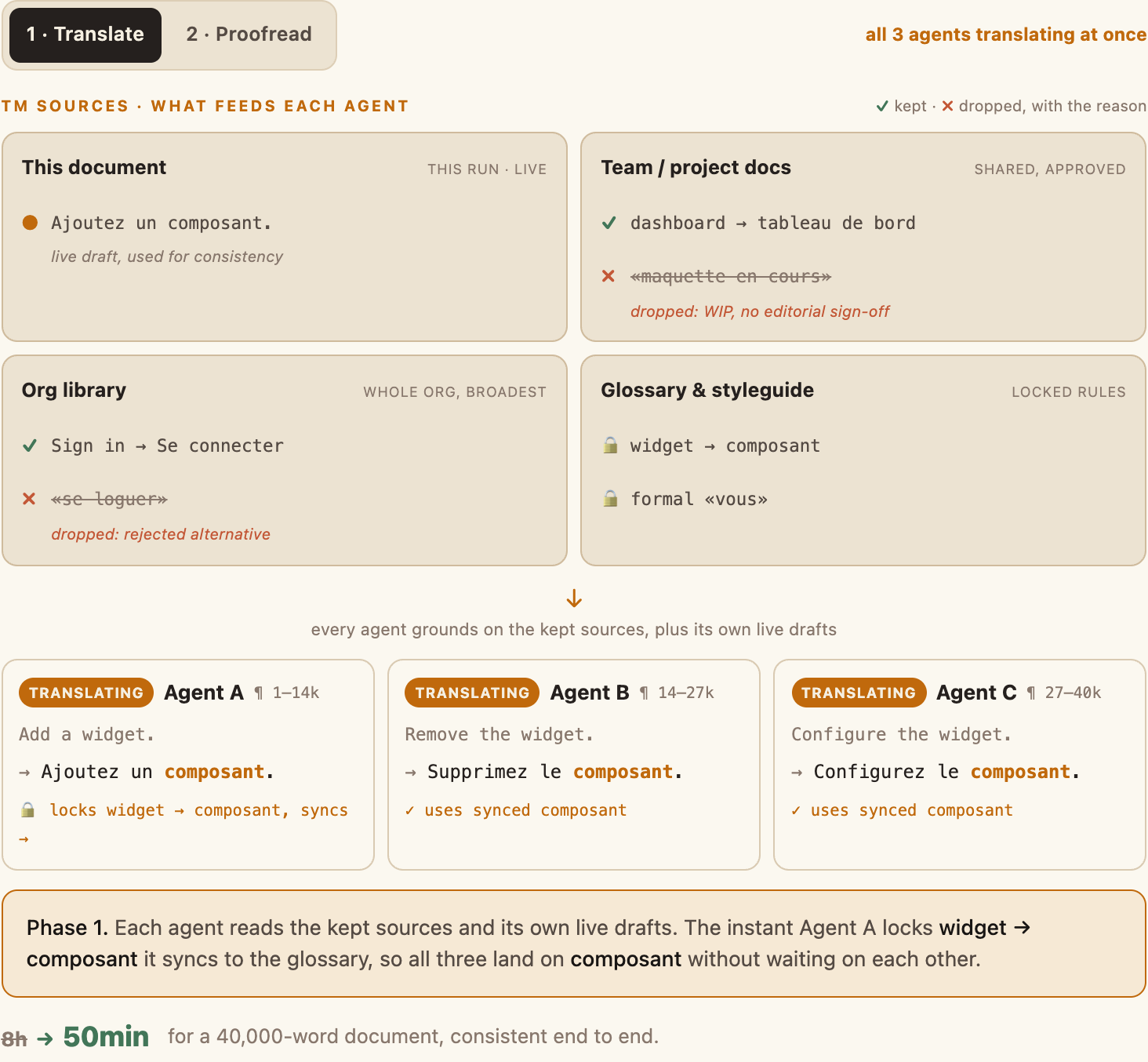
You can filter exactly what enters the memory: draw from an entire organizational library, narrow to one team's portfolio, or restrict it to a single project. By default the system only includes manually approved documents using TMS statuses, but you can override that at the team, document, or project level.
Both humans and AI agents see the most relevant previous translations — including rejected alternatives and the discussion behind the final decision. You don't just see what was chosen; you see why.
Gradient translation memory grounding
For automated AI flows we built what we call "gradient translation memory grounding" to help LLMs perform better:
- Real-time document syncing: while translating, the AI reads not only approved TM sources but also earlier segments in the same document — keeping terms, style, and choices consistent even without a strict glossary or styleguide.
- Safe proofreading: when the AI is proofreading or improving text, same-document segments are only used as context once the AI Editor has flagged them as approved. This stops the model from hallucinating or resurfacing earlier errors.
- Parallel agent syncing: when extra-large documents are translated by multiple agents at once, their memories constantly sync to propagate decisions across the whole text. This was a massive technical hurdle — but it cut translation time for a 40,000-word document from 8 hours to 50 minutes.
Extended context and workflow control
Once we had a way to capture good decisions and human talent, we pushed further into deep context and workflow convenience:
- Omnichannel context: chats, comments, and document search help both humans and AIs find the context behind a translation — web searches, dictionary queries, editor comments, and discussions with teammates and Literess.
- Adjustable workflows: Transept's automated workflows can improve documents using TM too. Rather than forcing a default behaviour, we let teams tune how memory behaves at each step.
- Version alternatives: translation version logs help teams remember which of many AI or human drafts was selected — so the memory can replicate the logic of a translation, not just the style.
- Literess in the review layer: Literess brings memory directly into review. She uses the glossary, styleguide, document context, previous segments, QA findings, and translation history to comment on the document, explain issues, suggest fixes, and help the human reviewer make the final call.
Human–AI feature parity
A core part of Transept's philosophy is feature parity. Because translators' workflows vary wildly, we make sure every tool, memory layer, and context window is equally available to human experts and AI agents.
The result is a memory layer that actively participates in the work. Instead of a human manually checking old files for how a word was translated, the system feeds that context to the AI during drafting, uses it to flag errors during QA, and surfaces it for the human reviewer.
The team stops managing repetitive consistency and goes back to deciding what sounds right. The AI makes sure nothing is forgotten, and Transept captures every creative or legal decision along the way.

The author
Co-founder of Transept, writing as “Mevkh.” A Language and Literature degree, then a turn into software: senior AI engineer shipping production LLM features to 50,000+ users — RAG, agentic tools, LLM-as-judge evaluation. A novelist on the slow path, with 120,000 words of satirical romance fantasy in a drawer. The friction between AI translation and his own prose is what set this whole thing in motion.