Not lost in translation. Found.
Transept is an AI translation workspace for people who put their name on the result: authors translating their own books, translators working for clients, and teams publishing in several languages. We built it in 2025, two literature graduates who looked for a tool that could carry our own writing into another language and didn’t find one. The AI drafts, a person decides, and every document keeps a record of which was which.

How it started
Two writers, one problem.
— Vitalii.I wrote 120,000 words of satirical romance fantasy: mages drowning in debt, a multiverse economy that makes Wall Street look ethical, and a love story tangled up in all of it.
— Mariia.I write semi-fictional stories about real people, built around how it felt. Most of the people I wrote about were from other countries. We met in English, spoke in English, lived those moments in English. So I wrote them that way too. But I sometimes wonder what version of them I missed by not writing them in their language.
— Vitalii.I hit the same problem from the other side. Every tool I tried preserved the words but killed the voice: tone, rhythm, wit, emotional texture. Nothing held. It all came back flatter than it went in.
— Both of us.So we did what we know how to do. We read the research on machine translation. We benchmarked Claude, GPT, Gemini and a handful of open models on the same 50-page chapter, judging each on accuracy, tone and whether the satire still landed. None of them got all three right, and each failed in its own way. So we built the tool we wished we’d had. We still use it every day: on our own manuscripts, and on this site, whose German, Japanese, Chinese and Spanish pages are translated in Transept with the same workflow you would use.
Where we stand on AI
The AI drafts, a person decides, and the record shows which was which. That is the rule Transept runs on, and the house rules under it:
- You approve every change. Literess, our AI editor, proposes a change and you accept or decline it. Turn on Allow All and her changes apply without the click, and they are still listed as hers.
- Your text never trains AI. Not our models, not our providers’. On every plan, Free included.
- We keep receipts. Every document records what the AI wrote and what you changed, accepted or approved. The originality report puts it on one page, counted by word.
- No detector tricks. We don’t sell “undetectable”. When a publisher, a journal or a client asks whether AI was used, the answer is yes, and the report shows the work you did on top.
Two more: our team doesn’t read your documents in routine work, and our logs never contain your text. The full version, with the lines we won’t cross and the rules on declaring AI use, is on Ethical and Responsible AI. Why we hold to it, Reddit posts and doom corner included, is in We love AI. But….
Who built this
We’re Mariia and Vitalii, the co-founders of Transept and its entire team. We met at Litero AI, an AI writing startup, where Mariia ran product and product marketing and Vitalii led AI engineering. We build Transept alongside our day jobs: Mariia builds product features and runs marketing, CRM and communications, and Vitalii builds the AI.
We are both Ukrainian, and we stand with Ukraine. Transept is run from Prague, your documents are stored in Germany, and every company that handles your data is listed on the sub-processors page. We test on our own writing first, and we publish what we measure in the journal: which model translates a novel best, what a translation costs in thinking tokens, what AI detectors make of an AI translation.
Mariia Ivakhnenko, co-founder
Two degrees in English Language and Literature, studied at three universities: a BA from Taras Shevchenko National University of Kyiv, an MA from the University of Ostrava, and an Erasmus+ exchange at the University of Salzburg. Languages: native Ukrainian, English at full professional proficiency (IELTS 7.0), conversational Czech, and learning German.
CRM and lifecycle marketing manager at Invity, a fintech app, where she runs onboarding, activation, retention and win-back across email, push and in-app messages for over 30,000 users. Before that, she ran email and lifecycle marketing at Snov.io, and at Litero AI she went from prompt engineer (2023) to product manager and product marketing manager. Certified in Anthropic’s Claude Code in Action (Mar 2026). At Transept she builds product features and runs marketing, CRM and communications.
Outside the day job, she writes semi-fictional stories about real people, built around how it felt. Work in progress, unpublished. What gets lost between languages is the question she keeps coming back to.
Vitalii Vlasiuk, co-founder
Bachelor’s in Language and Literature from Kyiv National Linguistics University, then a move into software. Native Ukrainian, English at full professional proficiency, learning German.
Senior machine learning engineer at SumUp, where he builds AI assistants for merchants and owns their evaluation: the benchmark infrastructure, a multi-agent business-intelligence assistant, and OCR document processing for support. Before that, a contract at Deloitte rebuilding the LLM judges behind a real-time healthcare assistant, and three and a half years of AI consulting for startups: LangGraph agents, RAG pipelines and production assistants in fintech and game development. Earlier, a senior AI engineer at Litero AI, shipping LLM features to 50,000 monthly active users. At Transept he is the machine learning and AI engineer behind the translation pipeline.
Also a novelist, in no hurry: 120,000 words of satirical romance fantasy sit in a drawer somewhere. The friction between AI translation tools and his own prose set this whole thing in motion.
Where this is going
Today Transept takes a book, a Word file, a PDF or a scan, translates it into any of 68 languages with your glossary, style guide and translation memory applied to every chapter, and holds every change for your review. Literess proposes fixes and runs the quality checks, and the originality report shows who wrote what. Translators and teams get the same editor with shared glossaries, comment threads, workflows and an API.
What comes next follows the same rule. Translation that gets closer to what a great human translator would do, with the person still deciding. More of the formats people publish in and the tools they already work in. And a record of the work that holds up wherever a translation gets asked about, by a publisher, a journal or a client.
For press
Writing about Transept, or about translating books with AI? The facts, the stories we can talk about, and logos and photos to download are below, and you can use them without asking. For an interview, a comment or a test account, email support@transept.ai with “Press” in the subject. It reaches the two of us.
Transept in brief
- Founded: in 2025 in Prague, Czech Republic, by Mariia Ivakhnenko and Vitalii Vlasiuk, who are still the whole team.
- What it is: an AI translation workspace for books and documents, used by authors translating their own books, by translators and by teams. It translates Word files, PDFs and scans into 68 languages with the user’s glossary, style guide and translation memory, holds every change for review, and records who wrote which words.
- Data: documents are stored in Germany, and customers’ text never trains AI models, ours or our providers’.
- Plans: a Free plan and paid plans, all on the pricing page.
About Transept, in one paragraph
Copy it as it is, or shorten it.
Transept (transept.ai) is an AI translation workspace for books and documents, founded in Prague in 2025 by Mariia Ivakhnenko and Vitalii Vlasiuk. Authors, translators and teams translate into 68 languages with their own glossary, style guide and translation memory, and review every change. Literess, Transept’s AI editor, proposes fixes and runs the quality checks, and an originality report shows which words the AI wrote and which a person wrote, edited or approved.
Stories we can talk about
- The first novel published with Transept. Passerby David, a science fiction author from Taiwan, translated his novel from Traditional Chinese into English and published it on Amazon in November 2026. He agreed to be written about under his pen name, and he read and corrected our article about him.
- What AI models do to a novel. We test models on our own fiction and publish the numbers: five tools on nine chapters of a novel, how much a translation model thinks, and whether AI detectors spot an AI translation.
- Two literature graduates who built the tool for their own books. How it started is at the top of this page.
- AI translation with a record of who wrote what. Where we stand on AI and authorship, and the rules we hold ourselves to, is on Ethical and Responsible AI.
Logos, photos and screenshots
- The seal: SVG · PNG, 512 px
- The seal with the name, for light backgrounds: SVG · PNG
- The same, for dark backgrounds: SVG · PNG
- Mariia and Vitalii: photo, 1,400 px wide
- The product: the editor · the Originality panel








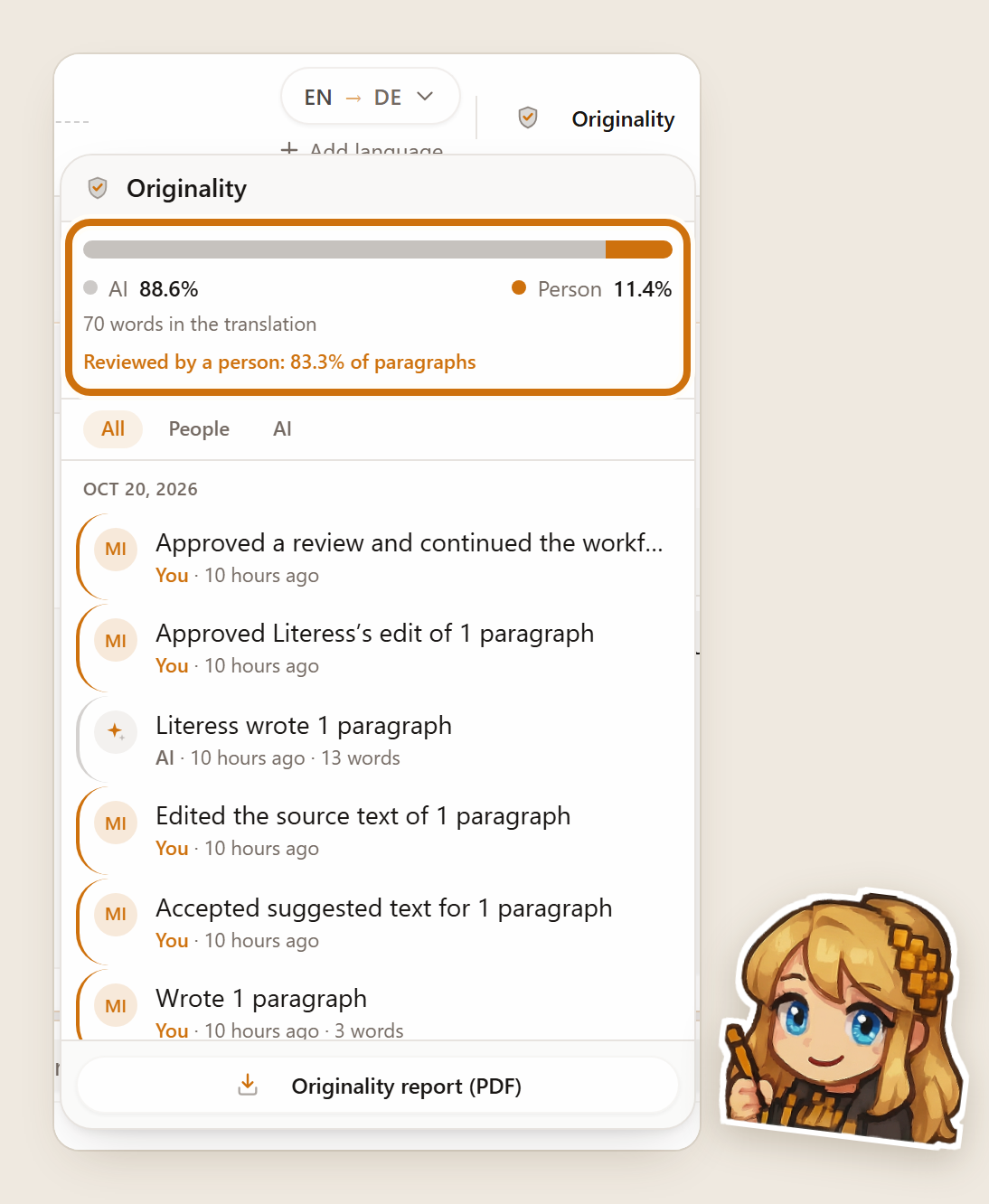
Use the logo as it is: the seal stays orange, never recoloured or outlined. Photos and screenshots are yours to use with a credit to Transept. If you need something else, a bigger photo or a particular screen, ask.
Say hi
We’re easy to reach. Word travels.
A question about how we use AI lands with the two of us, not a queue.