Can AI detectors spot an AI translation? We tested Pangram and GPTZero
We translated passages of a novel between Ukrainian, English and Chinese with AI and ran them through Pangram and GPTZero. Every sample came back human-written, a plain ChatGPT translation included. Here is why, and why you should still disclose an AI translation.


On this page
“Will my book get flagged as AI?” is the question we hear most from writers who translate their own novels. Behind it is a picture: a reader, an editor or a retailer pastes a chapter into an AI detector, and a red bar comes back.
So in October we ran the test on our own writing.

What did we test?
We took passages from Vitalii’s novel, a satirical fantasy that doesn’t have a title yet, and translated them with AI between Ukrainian, English and Chinese, in both directions. Then we gave every translation to the two detectors writers ask us about most, in the versions that were current in October 2026: Pangram 4, released in July, and GPTZero 4o, launched in September.
| What | How |
|---|---|
| Source text | Passages of an unpublished satirical fantasy novel, written by Vitalii |
| Languages | Ukrainian, English and Chinese, translated in both directions |
| Length | 100 to 1,300 words of source text (English translations of Ukrainian came out longer, up to 1,704 words) |
| Translations | Transept, with a glossary, a style guide and a proofread against the source |
| Control | The same passages translated by ChatGPT, with no glossary, no style guide and no editing |
| Detectors | Pangram 4 and GPTZero 4o, October 2026 |
Both detectors list Ukrainian and Chinese among the languages they support (Pangram, GPTZero).
What did the detectors say?
Every sample came back human-written, on both detectors, in every direction. The control did too: the plain ChatGPT translation scored 100% human-written.
| Translated into | Detector | Verdict |
|---|---|---|
| English, from Ukrainian | GPTZero 4o | Human, 97% and 98% |
| Ukrainian, from English | Pangram 4 | Human, 100% |
| Every other direction | Pangram 4 and GPTZero 4o | Human |
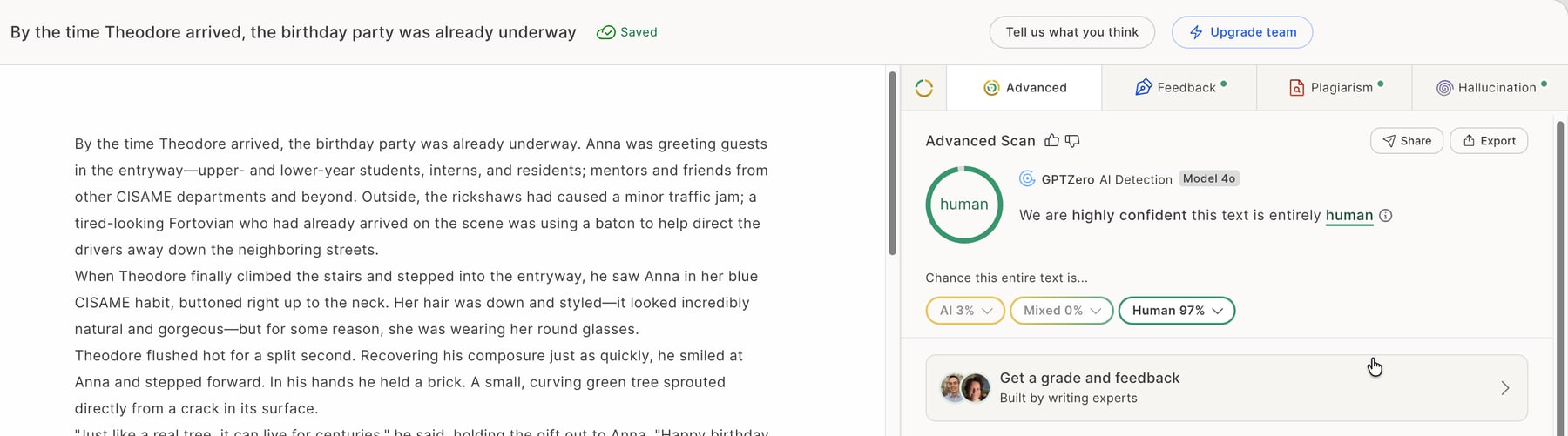
GPTZero 4o on 1,704 words translated from Ukrainian: 97% human.
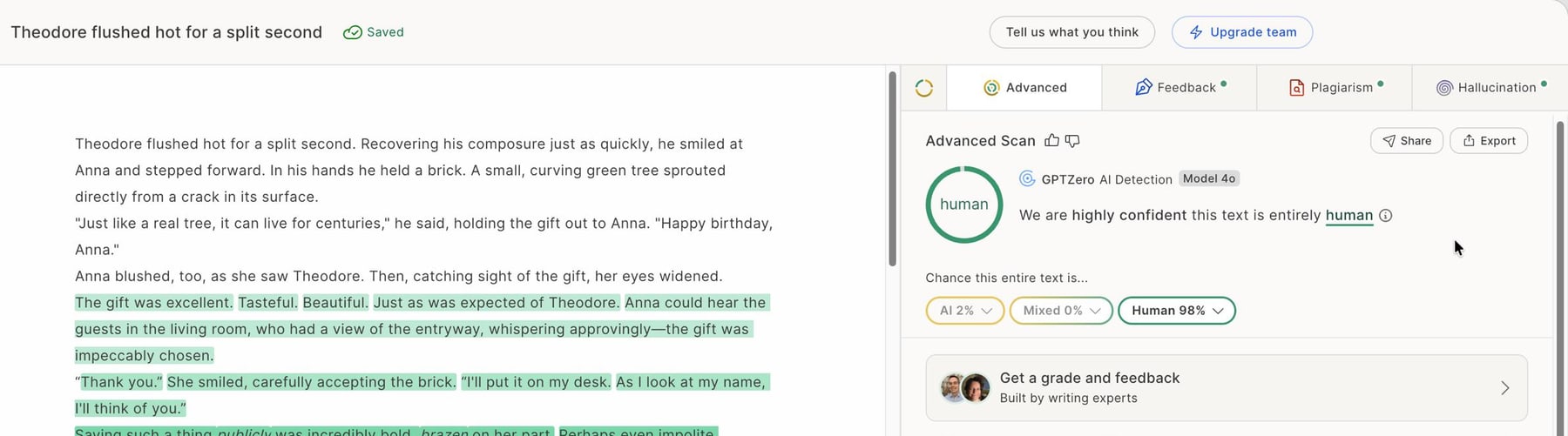
Another scene, 1,593 words: 98% human.
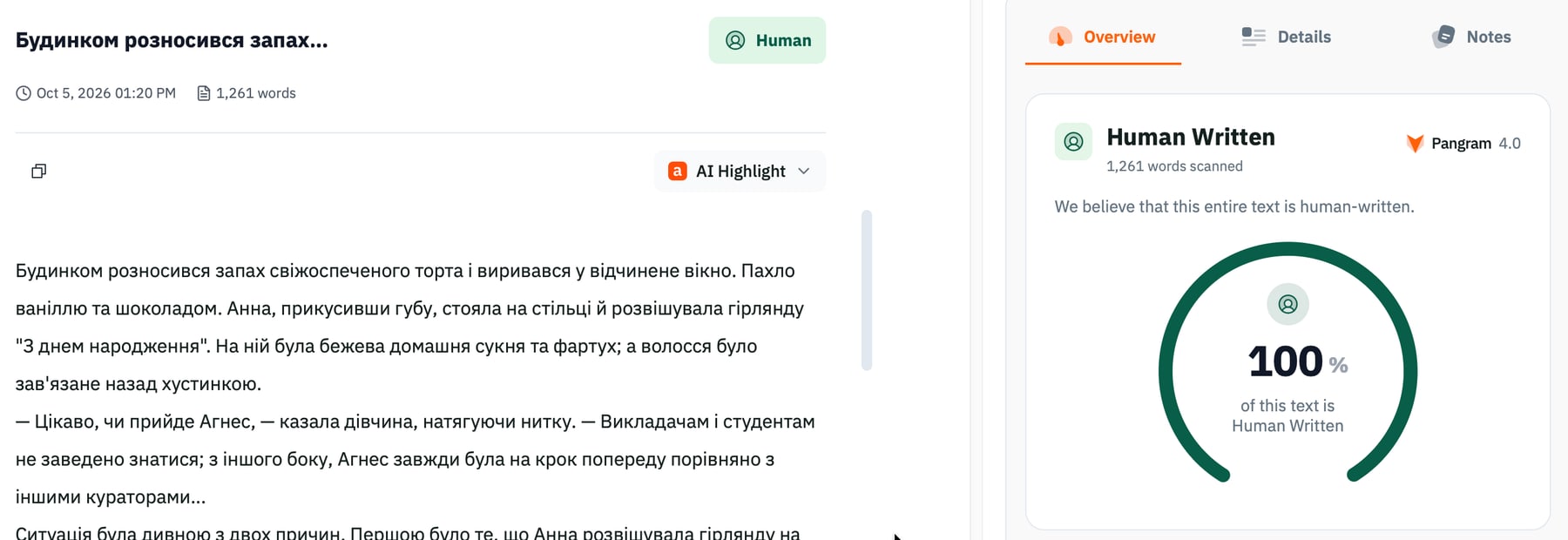
Pangram 4 on 1,261 words translated from English into Ukrainian: 100% human-written.

Why did they say “human”?
Because, by their own rules, that’s the right answer. A detector answers one question: did a model write this text? A translation of a novel keeps the writer’s decisions: the plot, the order of the scenes, who speaks, where the joke lands, how long a sentence runs before it breaks. The model picks the words in the other language for things a person already decided to say.
Pangram puts this in writing. The Pangram 4 technical report lists “literal translation” next to light copyediting and spelling fixes, as AI help so small that the text still counts as human. That is a change: Pangram’s previous model counted translation as light AI assistance. GPTZero publishes no rule on translated text that we could find, and its advice to students suggests it can still flag “heavily AI-influenced sections”. On our samples, it agreed with Pangram.
The same logic works the other way round. Translation doesn’t hide text a model wrote: Pangram says it recognises AI text after translation, double translation included, and its report lists repeated rounds of translation among the tricks its red team tried without getting through. A detector looks at who wrote the book. Who translated it is a different question.
Can you trust a detector score at all?
Treat it as one tool’s opinion on one day.
- Detectors change. GPTZero said in 2023 that its model is updated every two weeks, and Pangram changed how it treats translation between versions 3 and 4.
- They have accused people. In 2023, detectors flagged 61% of essays by non-native English speakers as AI-written (Liang et al.). The same year, a test of 14 detection tools found them neither accurate nor reliable, and found more false accusations on human texts that had been machine-translated (Weber-Wulff et al.). Newer models say they have fixed this. It is still a reason not to read a score as proof.
- The best-known one was withdrawn. OpenAI took its own AI text classifier offline in July 2023, citing its low accuracy.
- Some can’t read your language. Turnitin’s AI report accepts English, Spanish, Japanese and Arabic, so a Ukrainian or Chinese manuscript gets no score at all.
And a detector can’t judge quality. It gave the plain ChatGPT translation the same verdict as ours, so a “human” score tells you nothing about whether a translation reads well.
So do you still have to tell Amazon?
Yes. A detector asks who wrote the text. Amazon asks how it was made. KDP’s content guidelines define AI-generated content as text, images or translations created by an AI-based tool, and an AI translation stays AI-generated “even if you applied substantial edits afterwards”. So if you publish a book you translated with AI on KDP, you declare it, whatever a detector says about the text.
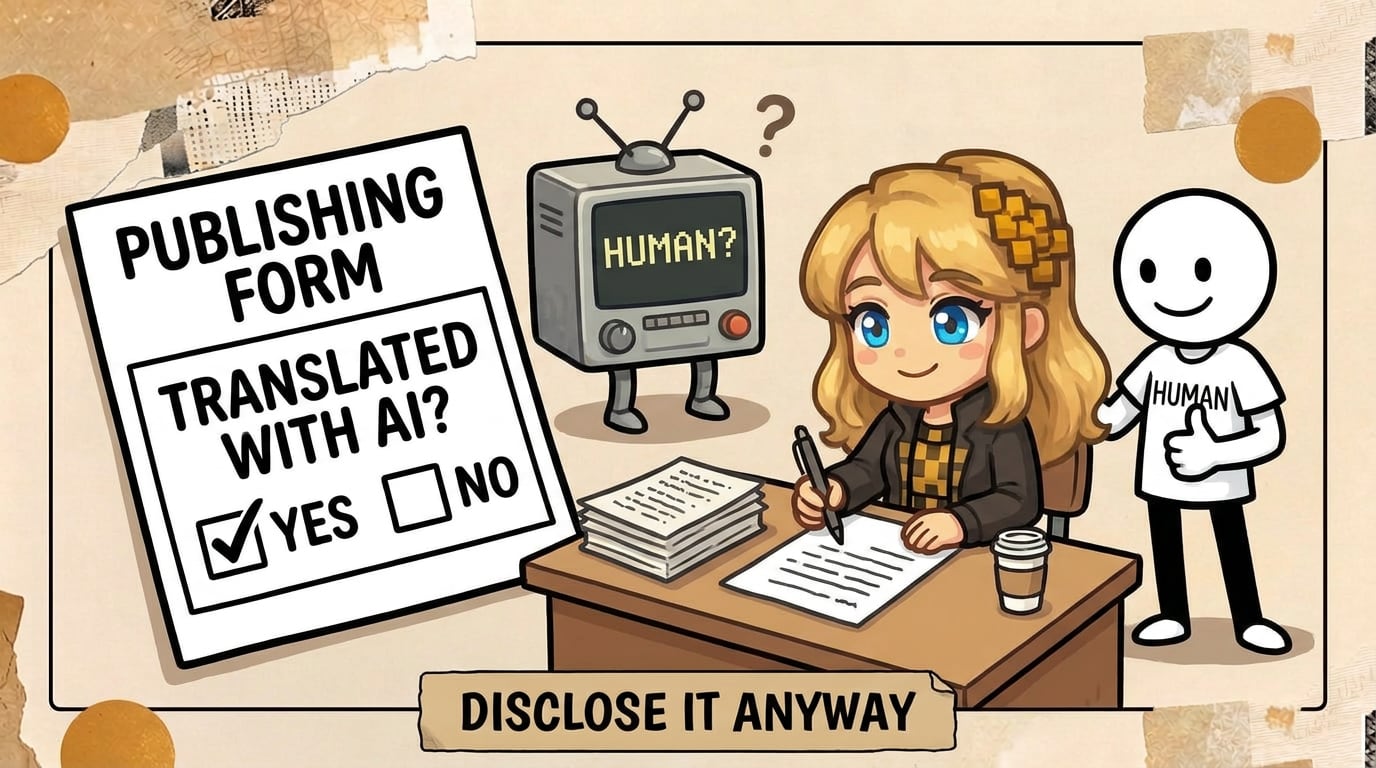
If you work with a publisher or an agent, the question is in your contract rather than in a detector. Ask before you start; our fiction translation page covers how authors handle it.
What does this mean for your book?
- Don’t use a detector as a test of your translation. It answers a question about authorship, and for a translated novel the author is still you.
- Don’t pay for a “humanizer”. It changes nothing about what you have to declare, and a translation of your own writing gives it nothing to fix.
- Check what readers notice: a name that changes spelling halfway through, a line that went missing, dialogue that went flat. A glossary for names and a proofread against the source catch most of it; reading every line yourself catches the rest.
- Declare AI translation wherever a platform asks.
What this test doesn’t show
- One novel, one genre, passages up to a scene long. We didn’t test whole books.
- Two detectors, in October 2026. Both update often, so a rerun next month could come out differently.
- We didn’t test Originality.ai, Copyleaks or Turnitin (which doesn’t read Ukrainian or Chinese).
- Our samples were translations of human writing. Text a model writes from scratch is the case detectors are built for, and Pangram reports that translating it doesn’t change the verdict.
We’ll rerun the test when the detectors update.

The authors
Co-founder of Transept. Three degrees in English Language and Literature — Kyiv, Ostrava, and a year in Salzburg — and a Ukrainian native who lives most of her writing life in English. Came into AI as a prompt engineer, then product and lifecycle marketing. She writes semi-fictional stories about real people, and keeps circling the question of what gets lost between languages.
Co-founder of Transept, writing as “Mevkh.” A Language and Literature degree, then a turn into software: senior AI engineer shipping production LLM features to 50,000+ users — RAG, agentic tools, LLM-as-judge evaluation. A novelist on the slow path, with 120,000 words of satirical romance fantasy in a drawer. The friction between AI translation and his own prose is what set this whole thing in motion.