We love AI. But…
We build with AI every day, and we read what people say about it every day too. Here is where Transept stands on AI, and the four rules our AI works under.


On this page
A confession first: we are AI people. We have worked with language models for years, we test every new one the week it ships (sometimes with a spreadsheet and a stopwatch), and Transept exists because Vitalii tried every machine translation tool on his 120,000-word novel and none of them kept his voice.
We also read the internet. Every day.

What is the internet saying about AI?
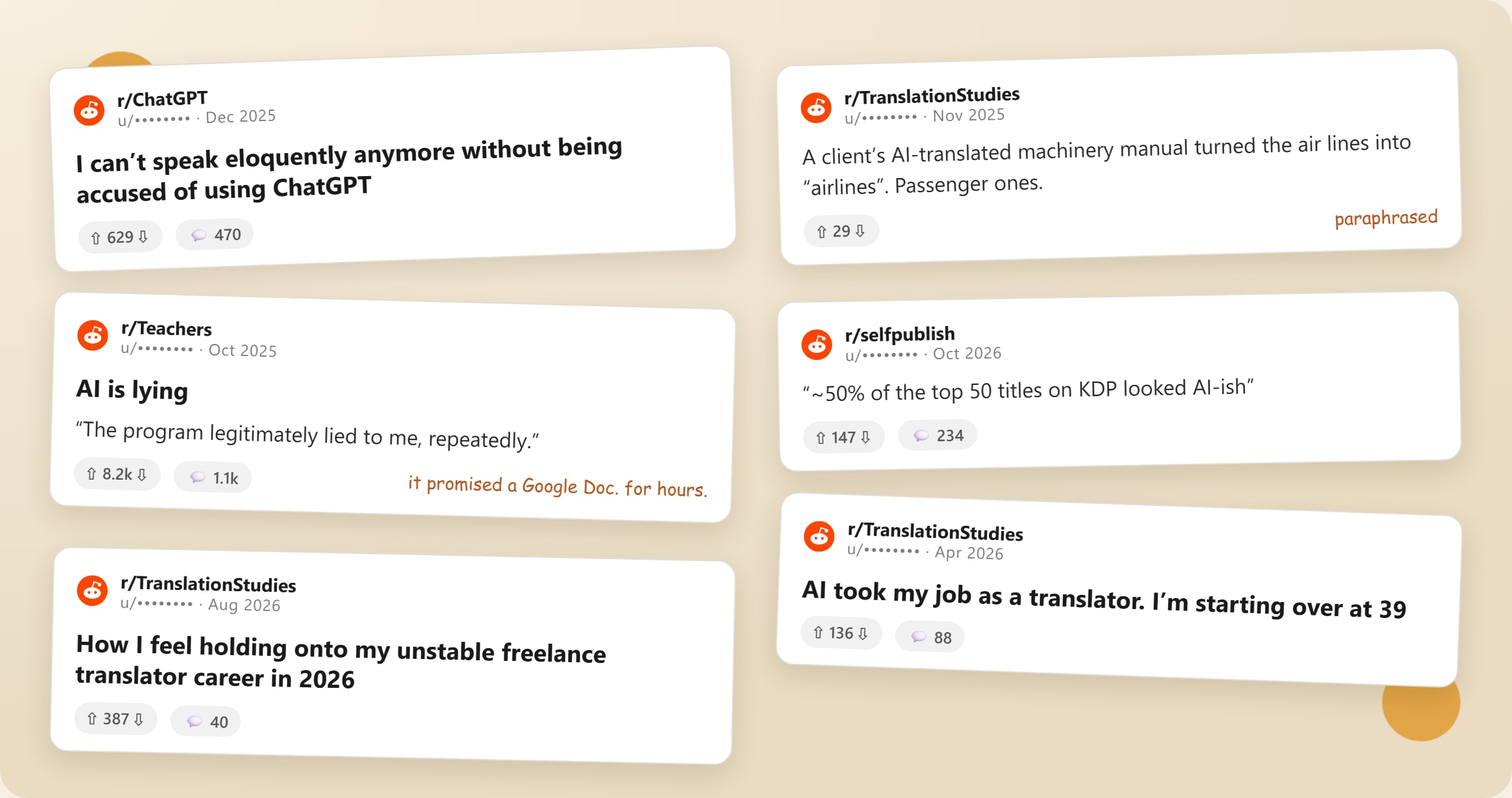
Real posts from Reddit, with the usernames hidden. The links are in the sources at the end.
Some of it is funny. A chatbot promising a Google Doc for hours. A machinery manual where compressed air turned into a fleet of passenger jets. Some of it isn’t funny at all: translators losing work, writers whose own sentences now get called “AI”, self-publishing charts filling up with mass-produced books.
The numbers agree with the mood. Half of American adults say they are more concerned than excited about AI in daily life, up from 37% in 2021 (Pew Research Center). In a 2024 Society of Authors survey, 36% of translators had already lost work to generative AI (European Writers’ Council).
And what about the end of the world?
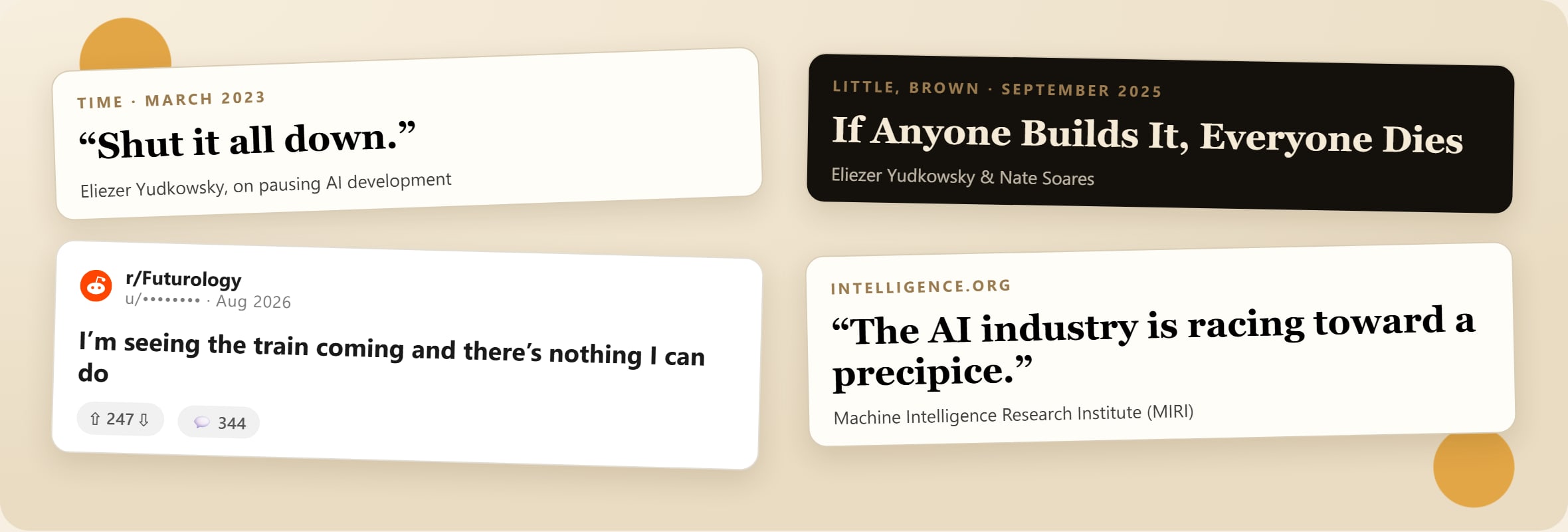
Then there is the doom corner. Eliezer Yudkowsky, who was warning about AI long before most of us had used it, wrote in TIME in 2023 that a pause isn’t enough and that we should shut it all down. In 2025 he and Nate Soares published a book with possibly the least ambiguous title in publishing history: If Anyone Builds It, Everyone Dies. The Machine Intelligence Research Institute, which he co-founded, now argues for a worldwide moratorium on building superintelligence.
We don’t build superintelligence. We build a translation editor.

But we took one idea from the doom corner seriously: the people who build with AI should say out loud what it is and isn’t allowed to do.
So where does Transept stand?
At Transept, the AI drafts, a person decides, and the record shows which was which.
AI is a terrific first-draft machine and a bad author. A translation has someone’s name on it, and that someone should be a person who read it, changed what needed changing, and stands behind it.
What are the house rules?
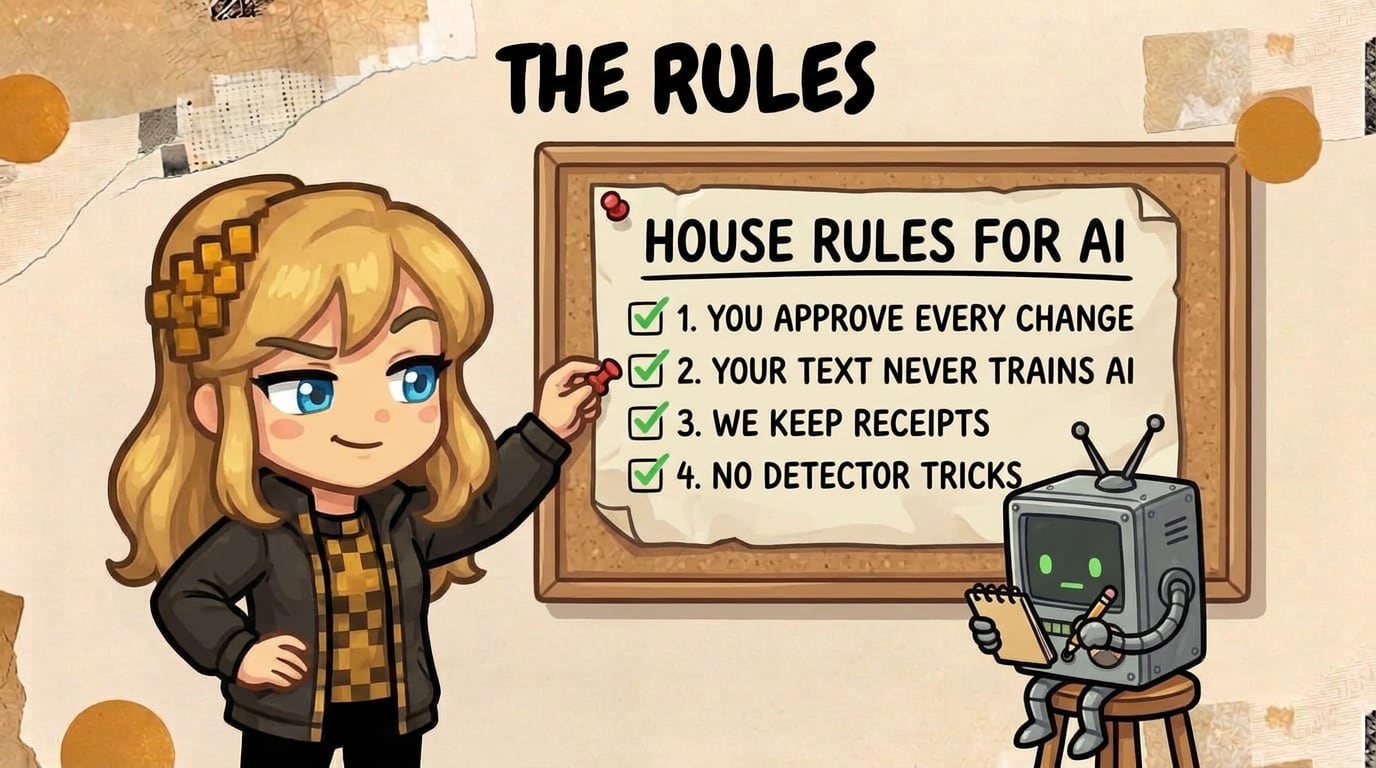
- You approve every change. Literess, our AI editor, proposes and you accept or decline. Proofreading fixes come one by one with Accept and Undo, and a workflow can stop at a review step until a person signs off. There is an Allow All switch for people who want her to just get on with it, and even then every change she makes is listed as hers.
- Your text never trains AI. Not our models, not our providers’. On every plan, Free included.
- We keep receipts. Every document records what the AI wrote and what you changed, accepted or approved. Before every export, Literess asks whether you read the translation through. And the new originality report puts it all on one page, counted by word.
- No detector tricks. We don’t sell “undetectable”. If your publisher, your journal or KDP asks whether AI was used, say yes, and show the work you did on top. (We tested the AI detectors anyway. It’s a fun read.)
Two more rules: our team doesn’t read your documents in routine work, and our logs never contain your text.
What does a receipt look like?
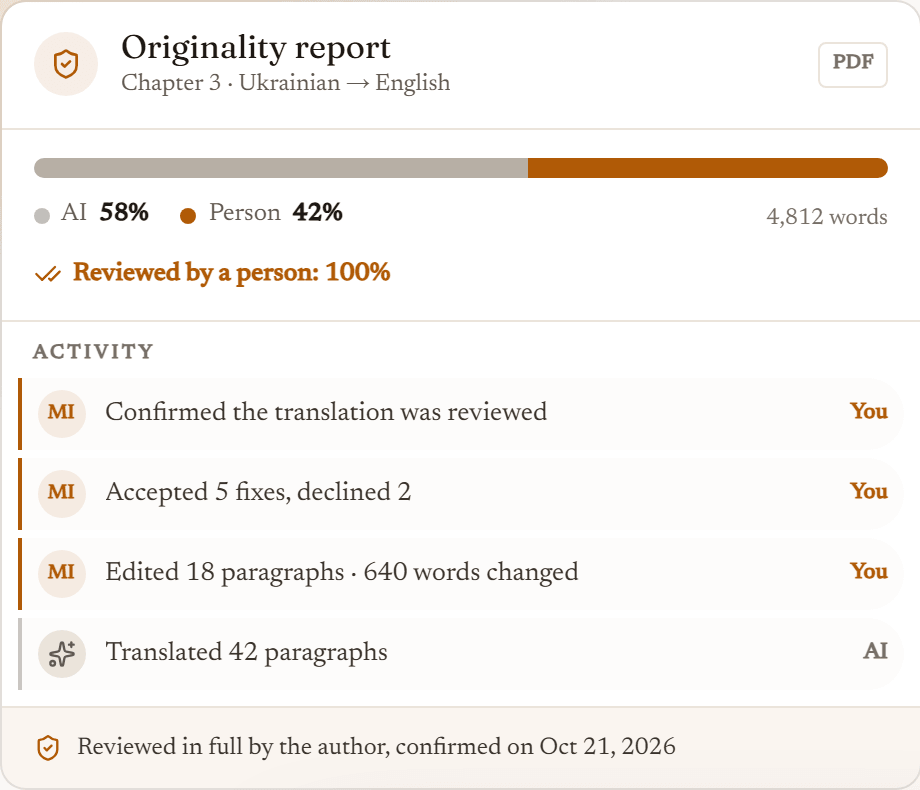
This is the originality report: the share of words the AI wrote, the share you wrote or changed, the paragraphs a person reviewed, and your dated sign-off. It is a record of how the text was made, not an AI detector, and it is the honest answer to “did you actually work on this?” The Free plan includes two reports, and every paid plan has as many as you need.

Where can I read the long version?
To see more details on how we tackle everything, read our new Ethical and Responsible AI page: what happens to your text, which providers see it, what we won’t do, and what the EU AI Act asks of published AI text.
We are still AI enthusiasts. We just like our enthusiasm with a seatbelt on.

Mariia and Vitalii
Sources
- Pew Research Center, How Americans View AI and Its Impact on People and Society, 17 September 2025: 50% more concerned than excited, 37% in 2021.
- Society of Authors survey, January 2024, as reported by the European Writers’ Council and Books+Publishing: 36% of translators had lost work to generative AI.
- Eliezer Yudkowsky, Pausing AI Developments Isn’t Enough. We Need to Shut it All Down, TIME, 29 March 2023.
- Eliezer Yudkowsky and Nate Soares, If Anyone Builds It, Everyone Dies, Little, Brown, 16 September 2025.
- Machine Intelligence Research Institute, homepage and about.
- The Reddit posts in the first picture: r/ChatGPT, r/Teachers, r/TranslationStudies, freelance career, r/TranslationStudies, airlines, r/selfpublish, r/TranslationStudies, starting over; and in the second: r/Futurology.
The authors
Co-founder of Transept. Three degrees in English Language and Literature — Kyiv, Ostrava, and a year in Salzburg — and a Ukrainian native who lives most of her writing life in English. Came into AI as a prompt engineer, then product and lifecycle marketing. She writes semi-fictional stories about real people, and keeps circling the question of what gets lost between languages.
Co-founder of Transept, writing as “Mevkh.” A Language and Literature degree, then a turn into software: senior AI engineer shipping production LLM features to 50,000+ users — RAG, agentic tools, LLM-as-judge evaluation. A novelist on the slow path, with 120,000 words of satirical romance fantasy in a drawer. The friction between AI translation and his own prose is what set this whole thing in motion.