The fun facts that weren’t
We make short videos about how languages say everyday things. Every fact has to pass two sources first, and some of the internet’s favourite language facts didn’t.

On this page
This autumn we started making short videos about how different languages say everyday things: what the rooster says, how you answer the phone, how a fairy tale begins. They run about a minute, every picture in them is drawn in code, and one of them has hundreds of likes on TikTok as I write this.
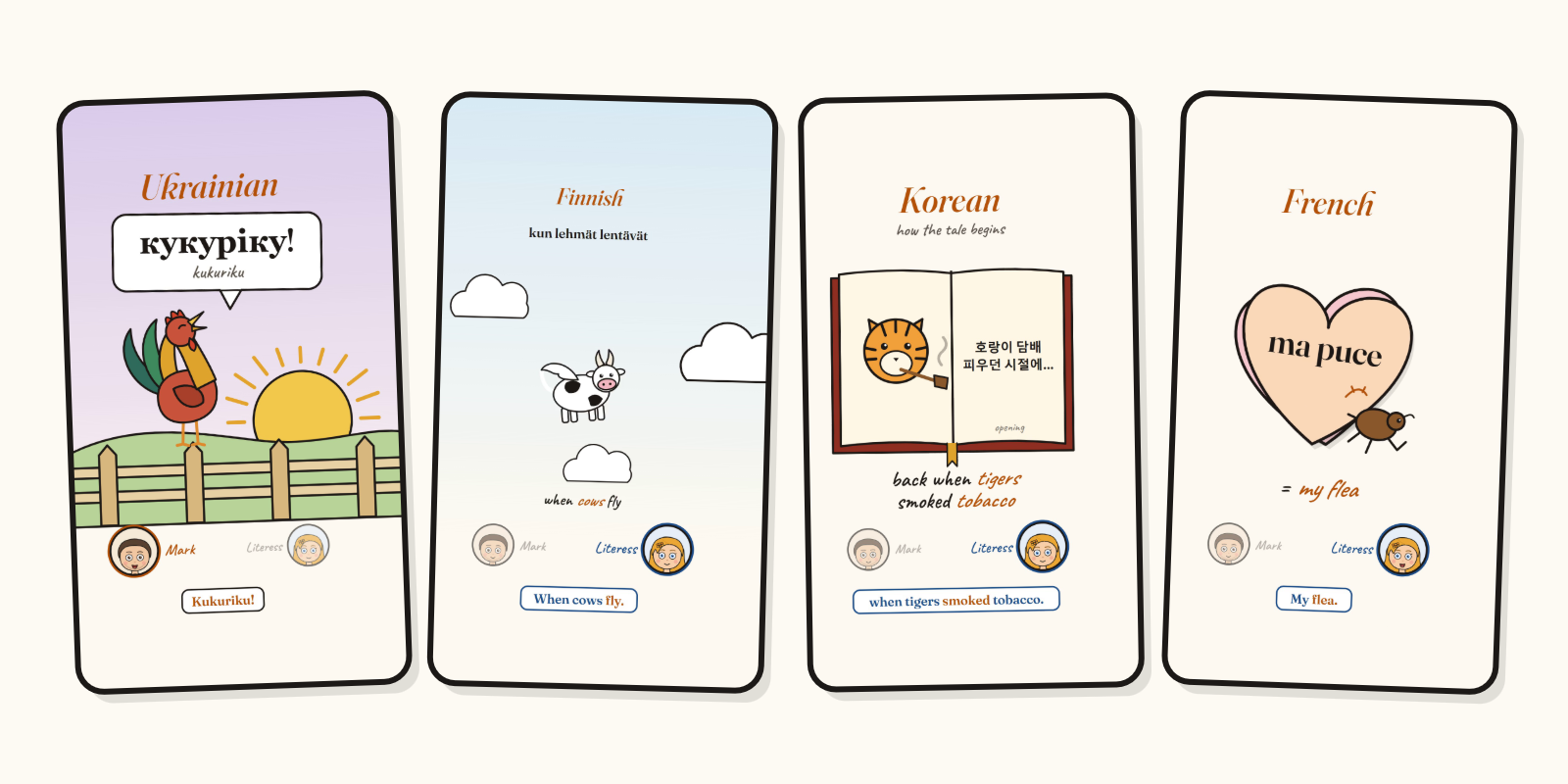
Frames from four of the nine videos so far.
Each video holds up to fourteen small facts, and we have one rule for all of them. A phrase goes in only when two independent sources agree on it, and one of the two is a dictionary or an original text.
I expected that rule to cost us an afternoon. It cost us some of our favourite lines.

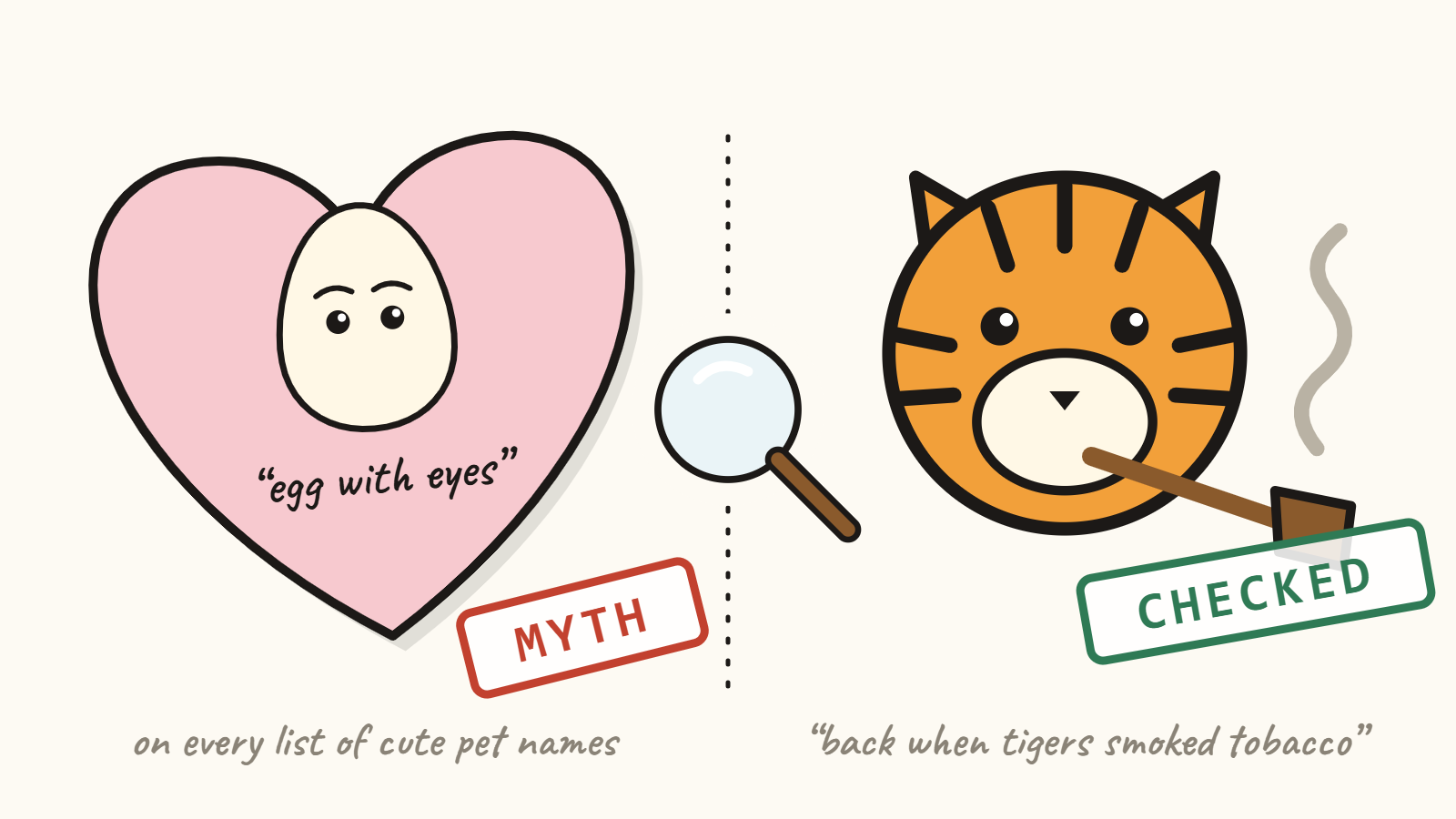
Do Japanese couples really call each other “egg with eyes”?
No. It turns up on list after list of cute pet names from around the world, and it was going to be the best line in our video about what people call their sweetheart.
We traced it to a BBC News Magazine feature from 2013, “Languages of love: 10 unusual terms of endearment”. It says that in Japan women “are frequently called ‘an egg with eyes’ by those who love them”, and gives the Japanese as “Tamago kato no kao”. Blogs and listicles have repeated the line ever since.
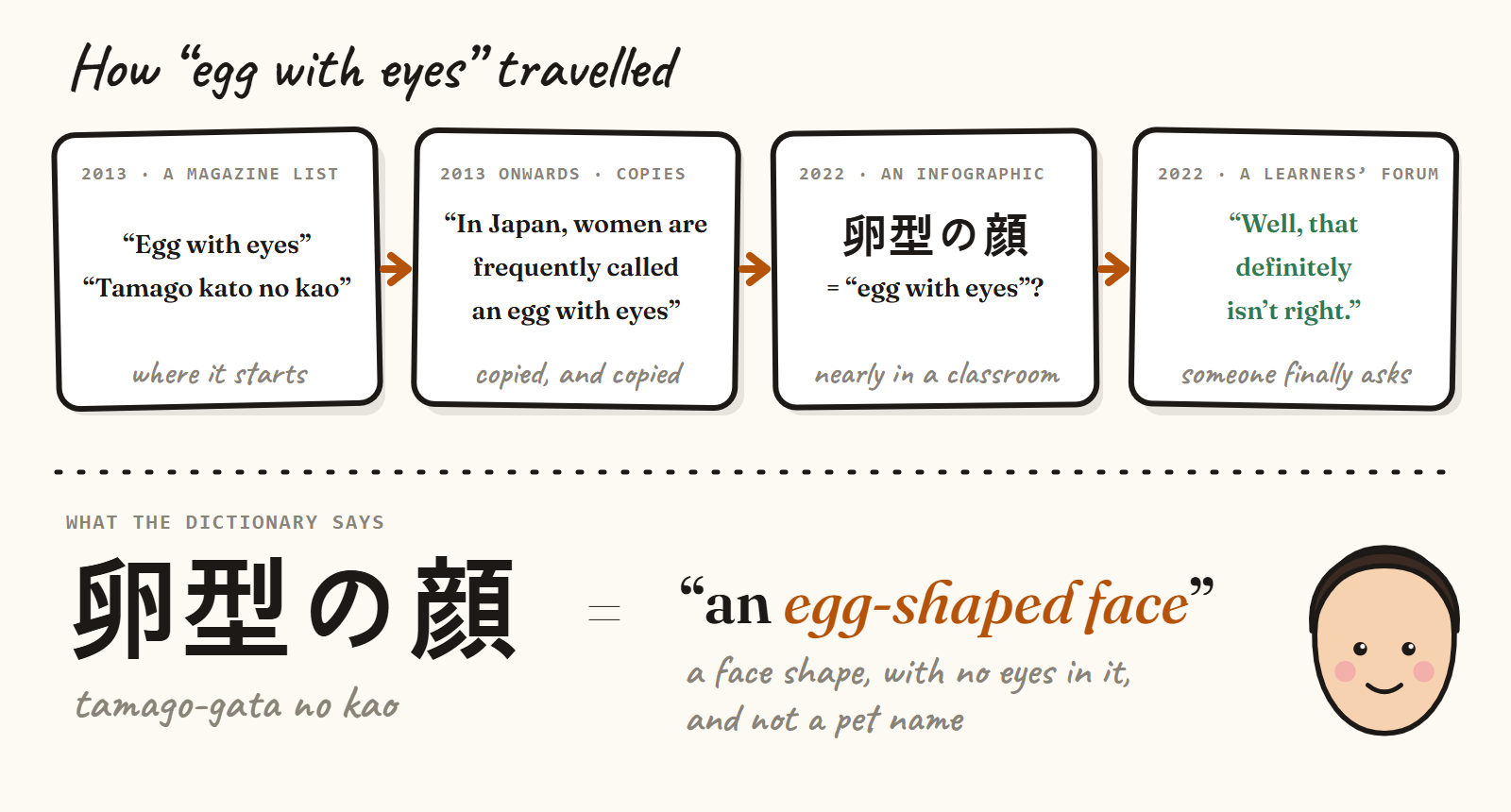
The phrase behind it, 卵型の顔 (tamago-gata no kao), is real Japanese. It means “an egg-shaped face”. It describes the shape of a face, the word “eyes” isn’t in it, and we found no dictionary that lists it as something you call a person.
Someone else had already asked. In 2022 a learner wrote on the WaniKani forum that a friend who teaches English was collecting pet names for an infographic, and that the internet had supplied this one. The first reply was: “Well, that definitely isn’t right.”
So the video has a French flea, a Polish frog and a Turkish liver in it, and no eggs.
How do we check a fun fact?
Every phrase goes through the same five steps before it reaches a script.
- Find it in its own writing. A fact that only exists in English is a warning sign. The BBC’s “Tamago kato no kao” has a typo in it, which is hard to spot without the Japanese next to it.
- Look it up in a dictionary of that language. For Spanish that meant the Royal Spanish Academy, for Ukrainian the academic dictionary, for Turkish the Turkish Language Association.
- Count copies as one source. Two lists that match word for word are one witness. The big online tables of rooster sounds are nearly identical to each other, so we counted them once.
- Keep the caveat. “One of several ways Korean tales begin” is harder to quote than “how every Korean story starts”, and it is the true one.
- Label it. Every item is marked solid, mostly solid or shaky. Shaky stays out of the script, however good the line is.
Which other facts didn’t pass?
Here are six more that we met in lists and search results, and what the sources showed.
| The claim as we met it | What we found |
|---|---|
| Spanish says “when cows fly” for “never” | It is on an uncited Wikipedia list and in no Spanish dictionary we could find. The Royal Spanish Academy has cuando las ranas críen pelo: when frogs grow hair. |
| Czech fairy tales begin “beyond seven mountains and seven rivers” | Polish tales go beyond seven mountains. Czech ones go beyond nine: za devatero horami a devatero řekami. |
| Japan’s sample taxpayer is “Taxpayment Taro” | Wikipedia says so. On the National Tax Agency’s own sample returns the name is 国税 太郎, Kokuzei Taro: National-Tax Taro. |
| Hausa storytellers open with “A story, a story. Let it come, let it go.” | The order is the other way round. The Paris Review and a 1913 collection of Hausa tales both have “Let it go, let it come.” |
| Vietnamese goosebumps are “snail bumps” | The word is gai ốc: “thorn” plus “snail”. |
| “Hello” comes from the Hungarian hallom, “I hear” | A legend. The Oxford English Dictionary’s first printed “hello” is from 1827, about fifty years before the telephone. |
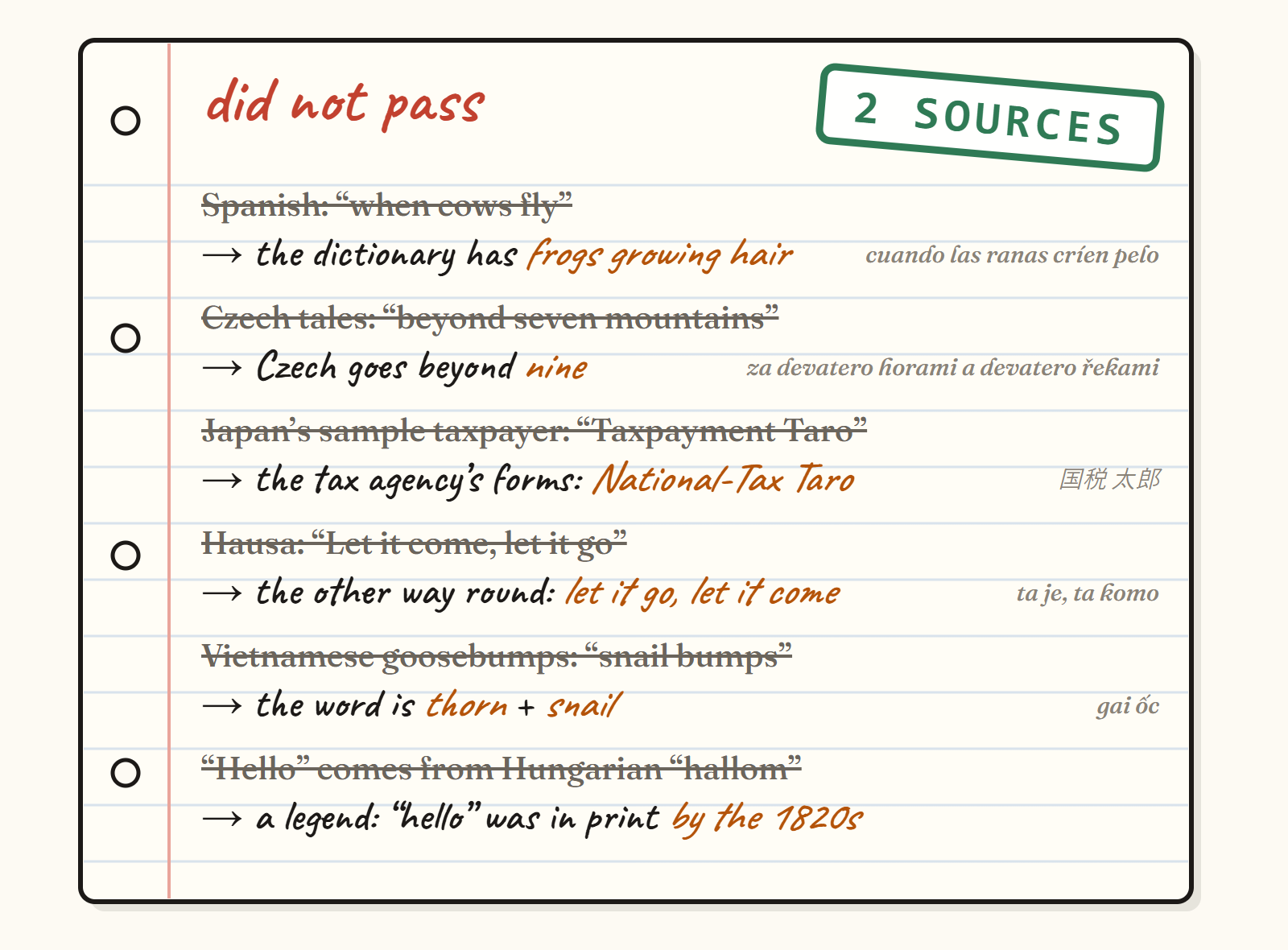
The Taro one is on us. We had already recorded the narration with the wrong name when the second check failed, and we recorded it again.
Where did our own AI tools get it wrong?
We use AI at every step of these videos, and some of its mistakes looked exactly like facts.
A search assistant summarized its results about pet names for us and reported that the Welsh word cwtch literally means “you bury me”. Cwtch is a cuddle. “May you bury me” is a Levantine Arabic endearment. Somewhere between the sources and the summary, the two had been joined into one confident sentence.
The AI model that reviews our finished videos told us one of them had no background music when it did, and flagged a speaker label that was correct.
We still use all of these tools. Their output goes through the same two-source check as a list or a blog post.

Which true facts are stranger than the myths?
Checking paid us back, because the real ones are better.
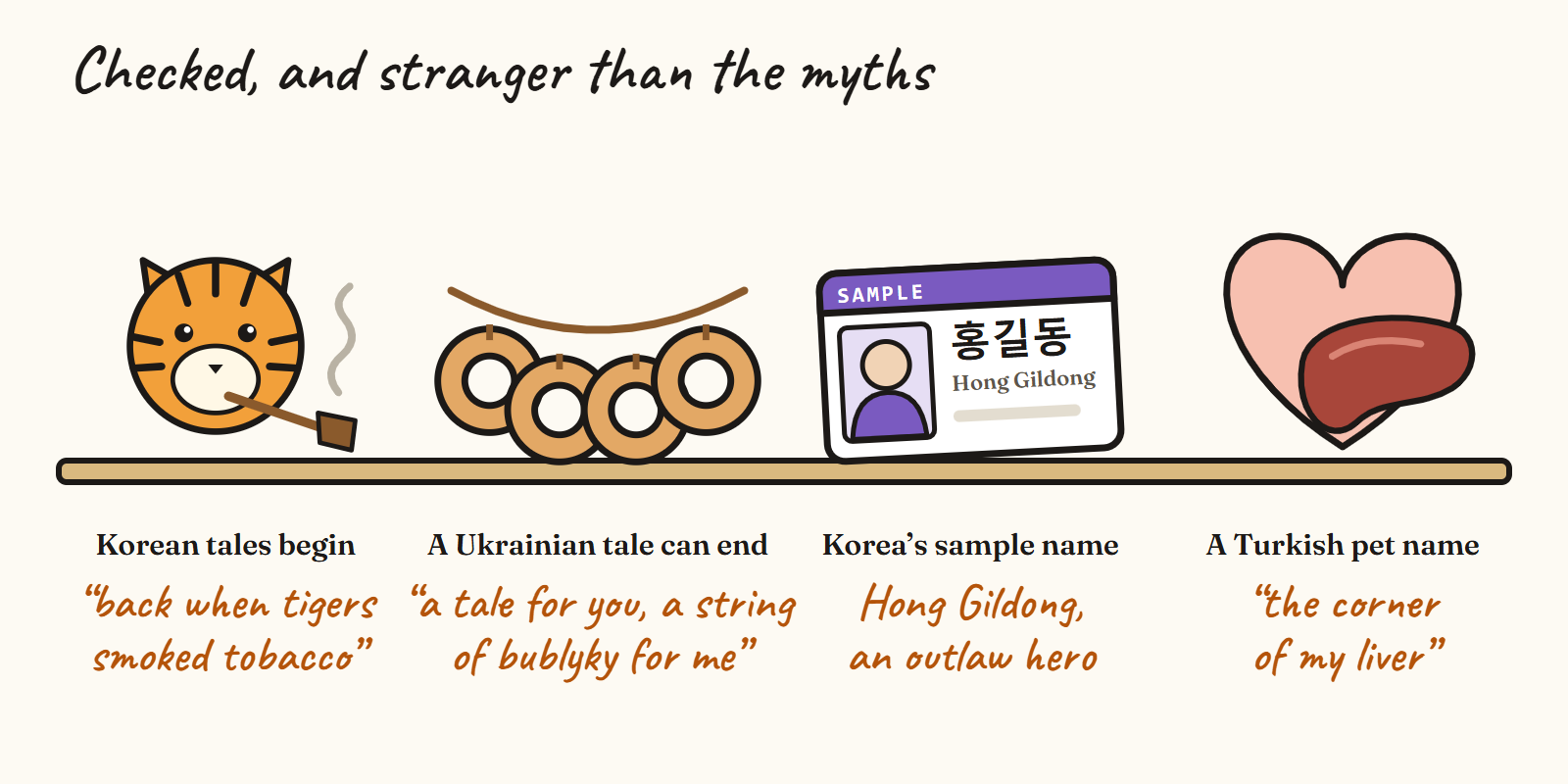
- Korean tales can begin “back when tigers smoked tobacco”. A 1926 story by the children’s author Bang Jeong-hwan opens that way.
- Turkish tales begin “when fleas were barbers and camels were town criers”.
- A Ukrainian tale can end with the storyteller’s bill: “there’s a tale for you, and a string of bublyky for me”. Bublyky are ring-shaped breads sold on a string, and the line is in a collection recorded in the 1890s.
- Korean forms use Hong Gildong as their sample name. He is the outlaw hero of a classic novel, and the novel’s translator, Minsoo Kang, confirmed the forms on NPR.
- Germany’s sample ID card has belonged to Erika Mustermann for years. Her surname means, roughly, “sample person”.
- Turkish and Mandarin both reach for the liver when they love someone: “the corner of my liver” and “heart and liver”.
- Alexander Graham Bell wanted people to answer the telephone with “ahoy”. Thomas Edison suggested “hello” in 1877, and “hello” won.
Why does a translation company care about a rooster?
The mistake behind “egg with eyes” is the one translation exists to prevent: trusting what a phrase is said to mean over what it means to the people who use it.
A word-for-word gloss can be accurate and still give the wrong idea. That is why our videos say “literally” so often, and why every entry in our research notes has a line called “Do not claim”.
It is also how we want Transept to work. The AI drafts, a person checks, and the record shows which was which. There is more about that in We love AI. But….
Do you know a fun fact about your language?
Tell us. Leave it under any video on our TikTok and we’ll check it against two sources before it goes anywhere near a rooster.

Mariia
Sources
- “Egg with eyes”: BBC News Magazine, “Languages of love: 10 unusual terms of endearment”, 2013, read through its reprint in The New Times, 1 June 2013. The forum question and reply: WaniKani Community, October 2022.
- “When frogs grow hair”: Real Academia Española, Diccionario del estudiante, entry rana. The uncited cows: Wikipedia, List of idioms of improbability.
- Nine mountains: the Czech Academy dictionary Slovník spisovného jazyka českého, entry devaterý.
- National-Tax Taro: Japan’s National Tax Agency, sample tax return filled in by 国税 太郎. “Nōzei Tarō”: Wikipedia, List of placeholder names, which is also where we read about Erika Mustermann.
- The Hausa opening: Anthony Madrid, “Once Upon a Time” and Other Formulaic Folktale Flourishes, The Paris Review, 23 May 2018; R. Sutherland Rattray, Hausa Folk-Lore, Customs, Proverbs, Etc., Oxford, 1913.
- Gai ốc: Wiktionary entries for the Vietnamese words gai and ốc, via the goose bump translation table.
- “Hello”, “ahoy” and Edison: Robert Krulwich, A (Shockingly) Short History Of “Hello”, NPR, 2011; Hagley Museum and Library, Thomas Edison suggested “Hello”. The Hungarian legend: Wiktionary, halló.
- Tigers and tobacco: Bang Jeong-hwan, 호랑이 형님, 1926, on Korean Wikisource.
- Fleas and camels: the Turkish folktale Tembel Kız on Turkish Wikisource.
- The string of bublyky: Borys Hrinchenko’s dictionary, entry в’язка; Етноґрафічний збірник, vol. 2, Lviv, 1896.
- Hong Gildong on forms: Minsoo Kang on NPR, The Story Of Hong Gildong Helps Define Korean Sense Of Identity, 14 March 2016.
- The liver: the Turkish Language Association’s dictionary, ciğerimin köşesi; Wiktionary, 心肝.
The author
Co-founder of Transept. Three degrees in English Language and Literature — Kyiv, Ostrava, and a year in Salzburg — and a Ukrainian native who lives most of her writing life in English. Came into AI as a prompt engineer, then product and lifecycle marketing. She writes semi-fictional stories about real people, and keeps circling the question of what gets lost between languages.